Blog

Types of Toyota Engine Noises To Pay Attention To

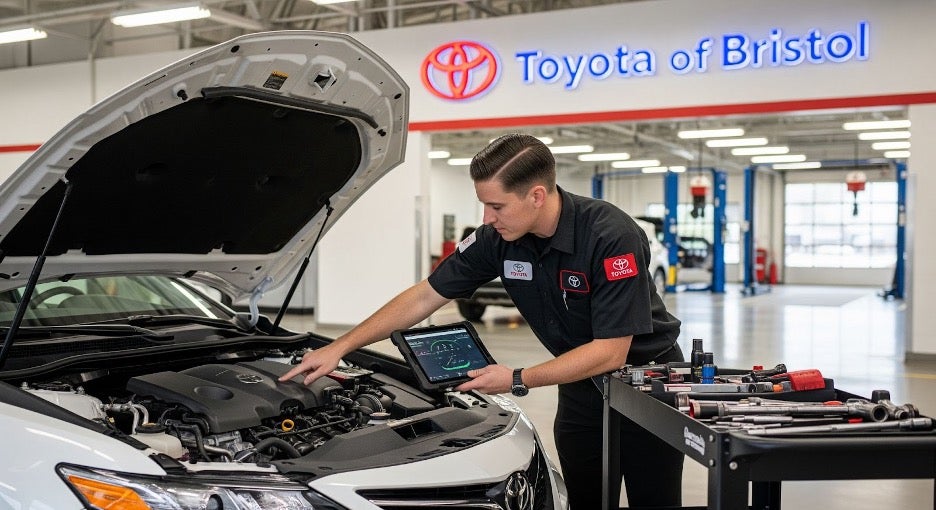
Toyota technician inspecting engine components of a Toyota sedan at Toyota of Bristol service center, with hood open and diagnostic tools in use.

Toyota is known for building durable and reliable cars, trucks, and SUVs, but even the most well-maintained vehicle may experience engine noise during its lifespan. Some noises are easy to diagnose and can be quickly cured with a minor repair or service. Others may indicate bigger, more serious engine problems.

This guide to Toyota engine noise diagnosis will help demystify Toyota engine knocking sounds and other noises, and explain when your vehicle may require the attention of our Toyota service center

Why Does My Toyota Engine Make Noise? 

Let's look at everyday Toyota engine noises, what they mean, and how to address them:

Knocking Sound 

 A "knock" is a common noise that often indicates poor-quality gas or that your car has been filled up with the wrong type of fuel. Consult your Toyota owner's manual to ensure you're using the recommended octane fuel for your vehicle. If it's too late for that, call a Toyota service center near you. Certified Toyota technicians can help you address potential fuel mix-ups.

If the problem persists, you may have other issues, such as a poor fuel/air mixture caused by faulty sensors or even worn bearings. Even if the "check engine light" in your Toyota isn't lit up, a persistent knocking sound should be investigated by our certified Toyota service center team

Rattling Sounds 

A rattle from your engine bay is another worrying noise that could indicate a number of car problems. Many Toyota engine rattling noises are caused by loose fasteners in the engine bay, particularly the exhaust heat shields. The bolts on these components experience significant heat and stress, which could cause them to wear down over time. 

You can test this once your engine is switched off and cooled down by gently tugging on the exhaust heat shield to see if it's loose. A Toyota technician can thoroughly investigate Toyota engine rattling noises for signs of valve train problems, timing belt issues, or problems with auxiliary systems, such as power steering or air conditioning. 

Whining or Screeching 

A high-pitched whine or screech when you first start your vehicle or accelerate may indicate loose belts in your engine bay. These belts stretch over time and require periodic inspection and adjustment from your dealer. These noises, while loud and somewhat alarming, can be solved relatively painlessly. 

Regular Maintenance Reduces Toyota Engine Noise 

Many Toyota engine problems that Bristol, TN, drivers face can be avoided with routine maintenance, as outlined in your Toyota owner's manual. Frequent oil changes, according to the recommended intervals, can help keep your engine from rattling or knocking by reducing wear and strain on components. 

Regular Toyota maintenance will also include fluid checks, belt inspections, and timing adjustments to prevent minor issues from becoming major problems. 

Trusted Toyota Service in Bristol, TN 

At Toyota of Bristol, our expert technicians know your Toyota better than anyone. If you're experiencing unusual noises you can't quite put your finger on, schedule a service appointment with our professional team to have your Toyota diagnosed and repaired.

Recommended Posts

AWD vs 4WD vs Hybrid AWD Which Toyota Drivetrain Fits Bristol Drivers?

AWD vs 4WD vs Hybrid AWD: Which Toyota Drivetrain Fits Bristol Drivers?

AWD, 4WD, and Hybrid AWD all send power to more than one axle, but they work differently and fit different needs. Traditional AWD on models like the Camry, Corolla, and RAV4 uses a mechanical system to automatically balance grip on paved roads. Part-time or full-time 4WD on trucks and body-on-frame SUVs like the Tacoma, Tundra, 4Runner, and Land Cruiser is built for low-traction, off-road, and towing situations. Hybrid AWD, which Toyota calls Electronic On-Demand AWD, uses a dedicated electric motor at the rear axle instead of a mechanical driveshaft, so it adds traction without much of a fuel economy penalty. Toyota of Bristol walks Tri-Cities shoppers through this comparison constantly, especially heading into fall and winter. Consider an Abingdon driver who splits time between flat Bristol streets and steep mountain grades on the way home. That driver needs a different answer than a Blountville homeowner who tows a boat every summer weekend. We wrote this guide to explain how each drivetrain actually works, which Toyota models offer AWD versus 4WD, which system fits mountain roads and winter weather best, and whether you genuinely need AWD at all based on how you actually drive. By the end, you will know exactly which drivetrain matches your routine instead of guessing from a window sticker, and which questions to ask before you sign anything. Definition: A drivetrain is the system that delivers engine or motor power to a vehicle's wheels, and it determines how many wheels receive power and under what conditions. All-wheel drive, four-wheel drive, and hybrid electronic AWD are three different approaches to that same goal. For drivers in Bristol, Kingsport, and Abingdon, choosing the right one affects traction, towing capability, and fuel economy across daily driving and mountain routes alike, which is why matching the system to your actual routine matters more than choosing the most advanced-sounding option. On this guide: Toyota AWD, 4WD, and Hybrid AWD Explained How Traditional AWD Works How Part-Time and Full-Time 4WD Work How Hybrid Electronic On-Demand AWD Works Which Toyota Models Offer AWD or 4WD? Drivetrain Availability by Model Matching Your Vehicle Type to Your Drivetrain Need Best Toyota Drivetrain for Mountain Roads and Winter Weather AWD vs 4WD for Towing and Off-Road Use Do You Really Need AWD in Bristol? Key Takeaways Frequently Asked Questions Compare Toyota AWD Vehicles in Bristol, TN Toyota AWD, 4WD, and Hybrid AWD Explained AWD balances traction automatically on paved roads, 4WD is built for low-traction and off-road situations, and hybrid Electronic On-Demand AWD uses a rear electric motor instead of a mechanical driveshaft to add grip with minimal fuel penalty. Shoppers often use these three terms interchangeably, but each one is engineered around a different priority. Understanding that difference upfront makes the rest of this comparison much easier to apply to your own driving. How Traditional AWD Works Traditional Toyota AWD, found on models like the RAV4, Highlander, and Sienna, constantly or automatically sends power to all four wheels using a mechanical connection between the front and rear axles. Here is what that means in practice: Sensors monitor wheel speed, steering input, and throttle position continuously. Power shifts between axles automatically without any driver input. The system is designed for on-road traction, not rock crawling or deep mud. It typically adds some weight and a modest fuel economy cost compared to a front-wheel-drive version of the same model. For a Bristol commuter cross-shopping a front-wheel-drive Camry against an AWD Camry, we recommend thinking about how often wet roads, light snow, or steep driveways factor into your actual week, since AWD's biggest advantage shows up in exactly those situations rather than in dry, everyday driving. It is easy to assume more traction is always better, but the added cost and modest fuel economy trade-off only make sense if those conditions actually come up often enough to matter. Drivetrain How It Works Best For Traditional AWD Mechanical link automatically balances power between axles Paved roads, rain, light snow, daily confidence Part-Time 4WD Driver engages 4WD manually for low-traction conditions Gravel, mud, snow, off-road trails Full-Time 4WD Power sent to all wheels continuously through a transfer case Mixed on-road and off-road use, frequent towing Hybrid Electronic On-Demand AWD Rear electric motor engages automatically, no mechanical driveshaft Efficient daily traction without a big fuel economy cost Based on Toyota official website. How Part-Time and Full-Time 4WD Work Part-time 4WD, common on trucks like the Tacoma and Tundra, requires the driver to manually engage the system for low-traction situations and disengage it for normal paved driving. Full-time 4WD, available on models like the Land Cruiser, stays engaged continuously through a transfer case, distributing power to all four wheels even on dry pavement. Both systems are built around towing capability and off-road durability rather than fuel efficiency. For a Blountville homeowner who tows a trailer full of mulch, tools, or camping gear most weekends, we recommend a 4WD Tacoma or Tundra over an AWD car or crossover, since 4WD's transfer case and low-range gearing handle towing and rough terrain in ways a traditional AWD system is not built to match. Full-time 4WD adds a small amount of everyday drag compared to part-time systems, but it removes the need to remember to engage anything before conditions change. How Hybrid Electronic On-Demand AWD Works Toyota's Electronic On-Demand AWD, available on hybrid models including the Camry, RAV4 Hybrid, Corolla Hybrid, and Highlander Hybrid, uses a dedicated electric motor at the rear axle instead of a mechanical driveshaft. When sensors detect front-wheel slip or hard acceleration, the rear motor engages instantly, then disengages when the extra grip is no longer needed. Because there is no center differential or driveshaft running the length of the vehicle, the system is lighter and adds less of a fuel economy penalty than traditional AWD. If you want to confirm which specific trims offer this hybrid AWD system on the model you are considering, our team can pull that information from current inventory before you finish comparing options. Availability shifts by model year, so a trim that included it last year is not guaranteed to include it again without checking the current lineup. Get Pre-Qualified Before You Compare Trims Which Toyota Models Offer AWD or 4WD? Sedans and crossovers like the Camry, Corolla, RAV4, and Highlander offer AWD or hybrid AWD, while trucks and body-on-frame SUVs like the Tacoma, Tundra, 4Runner, and Land Cruiser rely on 4WD systems built for towing and off-road use. Knowing which vehicles offer which system saves you from cross-shopping options that were never built to compete with each other in the first place. Drivetrain Availability by Model We put this table together because shoppers are often surprised at how many Toyota sedans now offer AWD, not just SUVs and trucks. Model Drivetrain Options Typical Buyer Corolla / Corolla Hybrid FWD standard; hybrid Electronic On-Demand AWD available on select trims Commuters wanting extra traction without a bigger vehicle Camry FWD standard; Electronic On-Demand AWD available Sedan buyers wanting light-duty winter confidence RAV4 / RAV4 Hybrid FWD standard; traditional AWD or hybrid AWD available Families and commuters wanting SUV versatility Highlander / Highlander Hybrid FWD standard; AWD or Electronic On-Demand AWD available Families needing three-row space and confidence Tacoma / Tundra 2WD or part-time 4WD depending on trim Towing, hauling, and off-road use 4Runner / Land Cruiser Part-time or full-time 4WD depending on model Serious off-road and mountain-terrain driving Best For / Ideal Use Case Choose AWD or hybrid AWD for cars and crossovers built around daily driving; choose 4WD for trucks and body-on-frame SUVs built around towing and off-road terrain. Based on Toyota official website. Based on our experience at Toyota of Bristol, the clearest way to sort this out is by vehicle type first. If you are looking at a sedan or crossover, the question is AWD versus hybrid AWD. If you are looking at a truck or body-on-frame SUV, the question is which 4WD system and how much low-range capability you actually need. Very few shoppers need to compare a sedan's AWD system directly against a truck's 4WD system, since the vehicles themselves usually already point toward the right category. Matching Your Vehicle Type to Your Drivetrain Need If you drive a sedan or crossover and mainly deal with rain, light snow, and steep driveways, then AWD or hybrid AWD covers that need well. If you tow a trailer, haul equipment, or drive unmaintained roads regularly, then a 4WD truck or SUV is the better match. If fuel economy matters as much as traction to you, then hybrid Electronic On-Demand AWD gives you both without the bigger fuel penalty of traditional AWD or 4WD. For a Kingsport family cross-shopping a gas Highlander AWD against a Highlander Hybrid AWD, we recommend the hybrid version if fuel economy matters as much as traction, since the electronic system delivers similar all-weather confidence with better mileage. For a Kingsport sedan buyer surprised to learn the Camry and Corolla offer AWD at all, we recommend test-driving both the FWD and AWD versions back to back, since the difference is subtle on dry pavement but noticeable the first time you hit a wet on-ramp or steep driveway. That side-by-side comparison tends to settle the decision faster than reading spec sheets alone. We invite you to stop by our showroom at 3045 W State St in Bristol so our team can show you exactly which trims on any model include AWD, hybrid AWD, or 4WD, since availability changes by trim year to year and a window sticker alone does not always make it obvious. Bring a description of your typical week, including how often you deal with rain, snow, gravel, or towing, and we can point you toward the right drivetrain instead of the most expensive one. We can also arrange back-to-back test drives so you can feel the difference between a FWD and AWD version of the same model before deciding. Whether you end up needing AWD, 4WD, or nothing extra at all, we would rather tell you that honestly than upsell a system you will not use. Financing terms and available incentives can also shift depending on trim and drivetrain, so it is worth confirming both before you settle on a final decision. Browse New Toyota AWD Inventory Best Toyota Drivetrain for Mountain Roads and Winter Weather Steep mountain grades near Abingdon and seasonal ice across the Tri-Cities call for different drivetrain priorities depending on whether your routine is mostly paved commuting or regular off-road and towing use. Local terrain changes the calculation more than most shoppers expect, and a drivetrain that feels like overkill in Bristol can feel just barely adequate twenty minutes away near the Virginia line. Matching Local Terrain to the Right System Here in the Tri-Cities, we see a wide range of driving conditions inside a single commute. Bristol and Kingsport city streets rarely demand more than light AWD confidence, while mountain routes near Abingdon and rural stretches around Elizabethton can turn icy or loose gravel quickly with elevation changes. Drivers who regularly access gravel roads, campsites, or unmaintained routes benefit more from 4WD's low-range capability than from AWD alone. Local Condition Recommended Drivetrain Driver Profile Bristol and Kingsport city driving, occasional rain FWD is often sufficient; AWD adds confidence Daily commuter Mountain grades near Abingdon, VA AWD or hybrid AWD for paved routes; 4WD if roads turn to gravel Cross-state commuter Rural routes near Elizabethton and Blountville AWD for pavement; 4WD for gravel or unmaintained roads Rural commuter Backcountry access near Johnson City and beyond Part-time or full-time 4WD Off-road or camping driver For an Abingdon driver whose commute includes steep, winding mountain roads, we recommend at least AWD or hybrid AWD as a baseline, and 4WD if any part of that route regularly turns to gravel or goes unplowed after snow. For an Elizabethton driver who mostly deals with paved rural roads but occasional icy mornings, hybrid Electronic On-Demand AWD often provides enough confidence without the added cost and fuel penalty of a full 4WD truck. The key is matching the system to the worst regular condition on your route, not the rare exception you might hit once a winter. Our team has helped drivers across Bristol, Kingsport, Johnson City, Abingdon, Blountville, and Elizabethton match their specific route to the right drivetrain for years, and that regional experience means we are not guessing based on a generic weather forecast. If you commute across a mix of city streets and mountain roads, tell us your actual route and we can recommend a drivetrain based on the worst conditions you regularly face, not just the easiest ones. We also recommend a test drive that includes any hills or curves similar to your real commute, since drivetrain confidence is easier to feel than to explain. You can schedule that test drive through toyotaofbristol.com or by calling our showroom directly. We would rather match you to the right system the first time than have you back next year wishing you had gone a different direction. That kind of honest guidance is part of why families across the Tri-Cities keep coming back to us for their next vehicle. Schedule a Test Drive AWD vs 4WD for Towing and Off-Road Use 4WD's transfer case, low-range gearing, and towing-focused engineering handle serious off-road terrain and heavy trailers better than AWD, which is tuned for paved-road traction rather than low-speed torque. This is where the two systems diverge the most clearly, since towing and technical off-road terrain expose limitations that rarely show up during normal commuting. Factor AWD 4WD Best surface Paved roads, light snow, rain Gravel, mud, rock, deep snow Low-range gearing Not available Available on most 4WD trucks and SUVs Towing focus Light-duty, model dependent Built around higher towing capacities Fuel economy impact Modest Larger, especially with part-time 4WD engaged Typical vehicle types Sedans, crossovers, hybrid SUVs Trucks, body-on-frame SUVs Best For / Ideal Use Case Daily drivers wanting light-duty traction Towing, off-road trails, and unmaintained roads Based on Toyota official website. For an Elizabethton camper who spends weekends on unmaintained forest roads, we recommend a 4WD 4Runner or Tacoma over an AWD crossover, since low-range gearing and additional ground clearance matter more on that terrain than the electronic responsiveness AWD offers on pavement. For a Bristol driver towing a boat to South Holston Lake most summer weekends, we recommend confirming the exact towing capacity of a 4WD Tacoma or Tundra trim rather than assuming any AWD crossover can handle the same load. Towing ratings vary meaningfully by trim, engine, and equipment, so the specific configuration matters more than the general model name. Research Tacoma's Towing and 4WD Capability Do You Really Need AWD in Bristol? Not every Bristol driver needs AWD, and being honest about your actual driving conditions can save you money without sacrificing meaningful safety or confidence. This section exists because we would rather earn your trust with an honest answer than sell every shopper the most expensive drivetrain option available. We would rather tell you the truth than sell you a feature you will not use. Here is how we recommend thinking about it honestly: If you mostly drive within Bristol city limits and rarely see snow that sticks, a FWD sedan may serve you just as well as an AWD version. If your commute includes any regular mountain grade, gravel stretch, or unplowed rural road, AWD or hybrid AWD earns its cost. If you tow, haul, or drive off-road regularly, no amount of AWD replaces what a proper 4WD truck or SUV is built to do. For a Johnson City driver who sees snow only a handful of days each winter, we recommend weighing the AWD price difference honestly against how often you would actually use it, since good winter tires on a FWD vehicle sometimes provide more real-world benefit per dollar than AWD alone. That is not a popular thing for a dealership to say out loud, but it is the honest answer for a lot of local driving patterns. If you do decide AWD is worth it, our service center can also inspect your AWD or 4WD system components during routine maintenance to make sure the investment keeps paying off. See What Our Service Center Checks Key Takeaways AWD balances traction automatically on paved roads; 4WD is built for off-road and towing use. Hybrid Electronic On-Demand AWD uses a rear electric motor instead of a mechanical driveshaft, adding traction with less fuel penalty. Sedans like the Camry and Corolla now offer AWD or hybrid AWD, not just SUVs and trucks. Mountain routes near Abingdon may call for AWD at minimum, with 4WD needed if roads turn to gravel. Not every Bristol driver needs AWD; honestly assessing your actual driving conditions can save money. Confirm exact drivetrain availability by trim and model year before you shop, since it changes from one year to the next. Toyota Drivetrain Questions Bristol Drivers Ask What is the difference between AWD and 4WD? AWD automatically balances power between the front and rear wheels for improved traction on paved roads, rain, and light snow, and it typically requires no driver input. 4WD, found on trucks and body-on-frame SUVs, is built for low-traction and off-road situations, often includes low-range gearing, and on part-time systems requires the driver to manually engage it. AWD prioritizes everyday confidence, while 4WD prioritizes towing and rugged terrain capability. Neither system is universally better; the right choice depends entirely on the vehicle type and how you actually use it. Which Toyota models offer AWD? Toyota offers AWD or hybrid Electronic On-Demand AWD on the Corolla, Corolla Hybrid, Camry, RAV4, RAV4 Hybrid, Highlander, and Highlander Hybrid, among others, with availability varying by trim and model year. This is one of the more common surprises we hear from shoppers who assume AWD is limited to SUVs and trucks. Confirming exact trim-level availability before you shop saves time, since not every trim of a given model includes the option. Is Toyota's hybrid AWD as capable as traditional 4WD? Hybrid Electronic On-Demand AWD is designed for everyday traction on paved roads, light snow, and rain, not for the low-range gearing and rugged off-road capability that traditional 4WD provides. For serious off-road trails, towing heavy loads, or unmaintained backroads, a 4WD truck or body-on-frame SUV remains the better match than any AWD or hybrid AWD system. Think of hybrid AWD as traction insurance for daily driving, not a substitute for a truck built around towing and trail use. Do I need AWD for driving in Bristol, TN? It depends on your actual routine. Drivers who mostly stay within Bristol and rarely see accumulating snow may not need AWD at all, while drivers who regularly cross mountain routes near Abingdon or rural roads near Elizabethton often find AWD or hybrid AWD worthwhile. We recommend being honest about your real driving pattern rather than assuming AWD is required by default. Talking through your typical week with our team usually settles the question faster than researching it alone. Compare Toyota AWD Vehicles in Bristol, TN We are here to help you compare AWD, 4WD, and hybrid AWD honestly, based on your actual driving conditions rather than a generic recommendation. Stop by our showroom at 3045 W State St in Bristol, TN, so our team can walk through which trims include which drivetrain across our current lineup. We proudly serve drivers across Bristol, Kingsport, Johnson City, Abingdon, Blountville, and Elizabethton, and we know these local roads well enough to give you a straight answer instead of a sales pitch. If mountain grades, towing, or winter weather are part of your routine, let us help you match the right drivetrain to your specific needs today. We would rather have that honest conversation up front than have you pay for capability you never end up using. That is the same approach we bring to every model on our lot, whether you end up driving away in a sedan, a crossover, or a truck. See Our AWD Vehicle Lineup Related Articles Keep reading more Toyota model guides and local driving advice from Toyota of Bristol. Off-Road Guide Best 2026 Toyota SUVs for Off-Road Adventures Near Bristol, TN See which Toyota SUVs and trucks fit serious trail use, towing, and mountain terrain. Read More Truck Capability What Is the 2026 Tacoma's Towing Capacity? See how drivetrain, payload, and equipment shape real-world Tacoma towing capability. Read More SUV Comparison 2026 Toyota RAV4 XLE vs XSE: Which Trim Fits Bristol Drivers? Compare RAV4 trims, including drivetrain and AWD availability, for Bristol and Tri-Cities driving. Read More SUV Sizing Guide How Big is the Toyota Grand Highlander? See how size, seating, and AWD availability compare for larger Toyota SUV shoppers. Read More

Best Toyotas for College Commuters in Bristol, TN

Best Toyotas for College Commuters in Bristol, TN

The best Toyotas for college commuters in Bristol come down to a short list: the Corolla for the lowest price and simplest ownership, the Corolla Hybrid for the best fuel economy on repeat highway trips, and the Corolla Cross or RAV4 for students who need more cargo room for gear, roommates, or trips home. Toyota of Bristol works with students commuting to East Tennessee State University in Johnson City, King University here in Bristol, and Milligan University near Elizabethton every semester, and the right choice usually depends on how far you drive, how much you can spend upfront, and whether you need extra space beyond a sedan trunk. Consider an ETSU student driving from Kingsport into Johnson City five days a week, watching every dollar of gas money while juggling a class schedule and a part-time job. That daily grind is exactly what this guide is built around. We wrote it to walk you through what actually matters in a commuter vehicle, how the Corolla compares to the Corolla Hybrid, when a Corolla Cross or RAV4 makes more sense than a sedan, and how new, certified pre-owned, and used options stack up on a student budget. By the end, you will know which Toyota fits your specific commute and your wallet, whether you are starting your freshman year or driving to campus for your final semester. Definition: A college commuter vehicle is a car chosen primarily for reliable, cost-efficient daily travel between home and campus rather than long-distance travel or heavy hauling. It is designed to balance low fuel and maintenance costs with dependable daily use. For students commuting to ETSU, King University, or Milligan from Bristol, Kingsport, or Elizabethton, it means a vehicle that keeps fuel and repair costs predictable across a full semester. On this guide: What Makes a Good College Commuter Vehicle? Fuel Economy and Ownership Cost Safety and Reliability Practical Considerations for Campus Life Toyota Corolla and Corolla Hybrid Comparing Corolla and Corolla Hybrid Which One Fits Your Commute Which Toyota Fits Your ETSU, King University, or Milligan Commute Toyota Corolla Cross and RAV4 Used and Certified Toyota Options for Students Key Takeaways Frequently Asked Questions Find Your Commuter Toyota at Toyota of Bristol What Makes a Good College Commuter Vehicle? A good commuter vehicle for students balances low fuel and ownership cost, standard safety technology, and enough practicality for campus life, without paying for size or features a daily commute does not need. Before comparing specific models, it helps to know what actually separates a good commuter car from one that simply looks appealing on a lot. Price matters, but so does how that price plays out over four years of ownership once fuel, insurance, and maintenance are added in. Fuel Economy and Ownership Cost For a student driving to campus most days of the week, fuel economy adds up fast over a semester. The 2026 Corolla starts around $23,500 and returns up to an EPA-estimated 35 mpg combined on gas, while the Corolla Hybrid starts closer to $24,975 and returns up to an EPA-estimated 50 mpg combined. Here is what we ask students to weigh: Total miles driven per week between home, campus, and work. Whether the extra hybrid cost pays for itself in fuel savings within a reasonable timeframe. Insurance cost differences, which can vary more by trim than by gas versus hybrid. Expected maintenance costs, including routine service covered under ToyotaCare on new purchases. For an ETSU student commuting daily from Kingsport into Johnson City, we recommend running the math on your actual weekly mileage before assuming the hybrid is automatically worth the higher price, since a shorter commute may not generate enough fuel savings to offset the difference as quickly as a longer one would. A rough rule we share with students is to multiply your daily round-trip mileage by the number of days you drive each week, then compare that weekly total against typical fuel prices in the Tri-Cities before deciding. Priority Why It Matters for Students Toyota Answer Low starting price Limited budget, financial aid, or family contribution Corolla LE gas trim Best fuel economy Long or frequent highway commutes Corolla Hybrid Cargo space Textbooks, instruments, sports gear, roommate moves Corolla Cross or RAV4 Standard safety tech Peace of mind for students and parents Toyota Safety Sense, standard across the lineup Predictable maintenance cost Limited budget for surprise repairs ToyotaCare coverage on new purchases Resale value Reselling after graduation Toyota's strong resale reputation across the lineup Based on Toyota official website. Safety and Reliability Toyota Safety Sense comes standard across the current Corolla, Corolla Cross, RAV4, and Camry lineups, which means students are not paying extra for core driver-assist features like pre-collision support and lane departure alerts. For parents helping a student choose their first car from out of state, that standard safety equipment often matters more than horsepower or styling. For a parent in another state helping their King University freshman pick a first car, we recommend prioritizing standard safety technology and Toyota's reliability reputation over trim-level styling, since those two factors do more for peace of mind across four years of ownership than upgraded wheels or a sportier badge. Reliability also matters more than it might seem during the school year itself, since a student without a backup vehicle cannot afford unexpected downtime during exam week or a work shift. Practical Considerations for Campus Life What we see students actually deal with day to day includes tight campus parking, limited driveway space at off-campus housing, and the reality of moving between dorms or apartments once or twice a year. A smaller Corolla is easier to park near campus housing in Bristol, while a Corolla Cross or RAV4 earns its keep during move-in and move-out weekends. Insurance is another practical factor students sometimes overlook until after signing, since rates can vary noticeably between a sedan and a crossover even within the same Toyota lineup. If you want to confirm which trims include ToyotaCare and how long that coverage lasts on a specific model, our team can walk through it with you before you commit to a purchase. See Your Toyota's ToyotaCare Coverage Toyota Corolla and Corolla Hybrid The Corolla and Corolla Hybrid share the same core reliability and safety equipment, so the decision mostly comes down to upfront price versus long-term fuel savings based on how much you actually drive. These two versions of the same nameplate are the most common starting point for students shopping with us, largely because the price gap between them is small enough that the decision often comes down to math rather than personal preference. Comparing Corolla and Corolla Hybrid We put together this comparison because students often assume the hybrid is simply the "better" choice without checking whether their specific commute makes the extra cost worthwhile. Feature Corolla (Gas) Corolla Hybrid Starting price Around $23,500 Around $24,975 EPA-estimated combined MPG Up to 35 mpg Up to 50 mpg Engine 2.0-liter 4-cylinder 1.8-liter 4-cylinder with electric motor Available AWD No Yes, on select trims Transmission CVT eCVT Toyota Safety Sense Standard Standard Best For / Ideal Use Case Students with shorter commutes who want the lowest upfront price Students with longer, frequent commutes who want to minimize gas station visits Based on Toyota official website. Based on our experience at Toyota of Bristol, the Corolla Hybrid earns its price difference fastest for students commuting from Kingsport, Abingdon, or other longer routes into Johnson City or Bristol, while a shorter drive within Bristol itself often does not rack up enough miles to make the hybrid's extra upfront cost pay off as quickly. Neither option is the wrong choice; the math simply favors different students depending on how far they actually drive each week. Which One Fits Your Commute If your daily round trip is under fifteen miles, then the gas Corolla likely saves you money overall once you factor in the lower purchase price. If you are driving thirty or more highway miles a day, then the Corolla Hybrid's fuel savings start adding up meaningfully across a semester. If you regularly deal with wet or snowy mountain routes near Abingdon, then the available all-wheel-drive Corolla Hybrid trims are worth a closer look. For a King University student living close to campus in Bristol, we recommend the gas Corolla LE because a short commute rarely generates enough fuel savings to justify the hybrid's higher price. For an ETSU student commuting daily from Kingsport, we recommend the Corolla Hybrid because the mileage adds up quickly enough to make the fuel savings meaningful within a couple of years. For a Milligan student who splits time between Elizabethton and winter mountain driving, we recommend looking at the Corolla Hybrid's available AWD trims for extra confidence on slick roads. For a transfer student who just moved to the area and is not yet sure how their new schedule will affect their weekly mileage, we recommend starting with the gas Corolla and reassessing after a semester, since it is easier to step up to a hybrid later than to have overpaid upfront for fuel savings you did not end up needing. We invite you to stop by our showroom at 3045 W State St in Bristol to sit in both the Corolla and Corolla Hybrid before deciding, since the difference in driving feel is small but noticeable once you compare them back to back. Our sales team can pull actual fuel cost estimates based on your specific commute distance so you are not guessing which option saves more over four years of school. If you are financing your first car, we can also walk through student-friendly financing options and what a realistic monthly payment looks like on each trim. Bring your class schedule or a rough idea of your weekly mileage, and we will help you run the numbers on the spot. Whether you end up with the gas Corolla or the hybrid, we want you leaving with a choice that fits your actual budget, not just a guess. Parents are welcome to join that conversation too, since financing decisions made together tend to hold up better than ones made under pressure the week before move-in. Browse Corolla and Corolla Hybrid Inventory Which Toyota Fits Your ETSU, King University, or Milligan Commute Your specific commute route, whether that is city driving in Bristol, the stretch into Johnson City, or the roads near Elizabethton, matters as much as the model you pick. We hear from students at all three schools every fall, and the same models tend to come up again once we match the vehicle to the actual drive rather than the school name alone. Matching Your Route to the Right Toyota Students commuting to King University mostly deal with in-town Bristol driving and short trips, which favors a lower-cost gas Corolla. Students driving to ETSU from Kingsport or Bristol cover more highway miles, which tips the math toward the Corolla Hybrid. Students near Milligan University, closer to Elizabethton, often deal with more rural roads and seasonal weather, which can make available all-wheel-drive trims or the added ground clearance of a Corolla Cross worth considering. School Typical Commute Pattern Toyota to Consider King University (Bristol) Short in-town driving Corolla LE gas ETSU (Johnson City) Longer highway commute from Kingsport or Bristol Corolla Hybrid Milligan University (near Elizabethton) Rural roads, seasonal weather Corolla Hybrid AWD or Corolla Cross Any school, moving weekends Occasional need for extra cargo space Corolla Cross or RAV4 For a King University student who mostly drives within Bristol between campus, work, and home, we recommend keeping it simple with the gas Corolla, since the shorter distances involved rarely justify a bigger upfront investment. For a Milligan student navigating rural roads near Elizabethton through the winter, we recommend at least test-driving a Corolla Hybrid AWD trim before settling on a front-wheel-drive-only option. Route and weather matter just as much as the school name itself, so students living off campus with a longer personal commute should weigh their actual drive, not just their university's general location. Our team works with students and parents from Bristol, Kingsport, Johnson City, Abingdon, Blountville, and Elizabethton every back-to-school season, so we know the routes and the routines fairly well by now. If you are choosing between two models and cannot decide, tell us your typical week, including class days, work shifts, and how often you head home on weekends, and we can point you toward the option that actually fits rather than the one that just sounds good on paper. We recommend scheduling a test drive before you commit, since seat comfort and visibility matter more on a daily commute than they do on a single weekend trip. You can request a test drive through toyotaofbristol.com or by calling our showroom directly. We treat student budgets seriously, not as an afterthought to a bigger sale, and that includes being upfront when a less expensive option genuinely makes more sense for your situation than the vehicle with the bigger markup. Schedule a Test Drive Toyota Corolla Cross and RAV4 When a sedan trunk is not enough, either because of gear, roommates, or regular trips home, the Corolla Cross and RAV4 both add meaningful cargo space without losing Toyota's fuel efficiency and reliability reputation. Not every student needs the extra size, but for the ones who do, the choice between these two usually comes down to how much cargo room you need versus how much you want to spend. Feature Corolla Cross RAV4 Size Compact crossover, smaller footprint Larger compact SUV, more interior room EPA-estimated combined MPG Competitive with Corolla sedan trims Slightly lower than Corolla Cross, still efficient for its class Cargo space More than a Corolla sedan, less than RAV4 Most cargo room of the two Available AWD Yes, on select trims Yes, widely available Best for Students who want SUV height and cargo without stepping up to full RAV4 size Students hauling more gear, instruments, or regularly moving between housing Based on Toyota official website. For a Milligan student who splits time between campus near Elizabethton and trips home most weekends, we recommend the Corolla Cross because the added cargo room and available AWD handle both routines without the higher price of a full RAV4. For a graduate student in Kingsport hauling equipment or instruments to campus regularly, we recommend the RAV4 because the extra cargo volume makes a genuine difference when a sedan trunk simply is not enough. Either model still keeps fuel costs closer to a sedan than many buyers expect, which matters when a student is already budgeting tightly for the semester. Browse Corolla Cross and RAV4 Inventory Used and Certified Toyota Options for Students A certified pre-owned Toyota often gives students most of the reliability and warranty confidence of a new vehicle at a meaningfully lower price than buying new. Budget usually drives this conversation more than any other part of the buying process, so we lay out the three main paths plainly rather than pushing students toward the most expensive option by default. Option Price Point Warranty Confidence Best For New Highest Full factory warranty and ToyotaCare Students who want the newest safety tech and longest ownership runway Certified Pre-Owned Moderate Extended warranty coverage backed by Toyota Students who want warranty confidence at a lower price than new Standard Used Lowest Limited or no remaining factory warranty Students on the tightest budget who accept more ownership risk Based on Toyota official website. We recommend thinking through these before deciding which route fits your situation: If your budget is tight but you still want warranty protection, then a certified pre-owned Corolla is worth prioritizing over a cheaper standard used option. If you plan to keep the car well past graduation, then a new purchase with full ToyotaCare coverage may be worth the higher upfront cost. If you are buying your very first car and want the lowest possible payment, then a standard used Corolla can work if you budget for maintenance without a warranty cushion. For a parent buying a first car for their King University freshman on a strict budget, we recommend starting with our certified pre-owned Corolla and Corolla Cross inventory, since the extended warranty coverage reduces the chance of an unexpected repair bill landing in the middle of a semester. We can also walk through how many miles remain on a specific certified vehicle's coverage, which helps put a real number behind the peace of mind rather than a vague promise. Get Pre-Qualified Before You Shop Key Takeaways The gas Corolla offers the lowest starting price; the Corolla Hybrid pays off fastest on longer commutes. Toyota Safety Sense comes standard across Corolla, Corolla Cross, RAV4, and Camry, so safety tech is not an upgrade cost. Students near Milligan or driving mountain routes should consider available AWD trims. The Corolla Cross and RAV4 add cargo room for gear, instruments, or moving weekends. Certified pre-owned Toyotas offer warranty confidence at a lower price than buying new. College Commuter Toyota Questions Students Ask What is the best Toyota for a college commuter in Bristol, TN? The best choice depends on your specific commute and budget. For short in-town driving, we recommend the gas Corolla for its low starting price. For longer highway commutes into Johnson City or from Kingsport, the Corolla Hybrid's fuel economy typically saves more money over a semester. For students needing extra cargo space, the Corolla Cross or RAV4 are worth considering over a sedan, especially during move-in and move-out weekends when trunk space alone rarely cuts it. Is the Corolla or Corolla Hybrid better for students? Both share the same core reliability and standard safety equipment, so the decision mostly comes down to your commute distance and budget. Students with shorter drives often save more overall with the lower-priced gas Corolla, while students covering longer or more frequent highway miles typically make back the Corolla Hybrid's higher price through fuel savings within a couple of years. If you are not sure which category your commute falls into, our team can help you estimate it before you decide. Should a college student buy a new, certified pre-owned, or used Toyota? This depends on budget and how much warranty protection matters to you. A certified pre-owned Toyota often gives students most of the confidence of buying new, including extended warranty coverage, at a meaningfully lower price. A standard used Toyota can work well on the tightest budgets, but students should plan for maintenance costs without a warranty cushion in place. If graduation is still several years away, leaning toward certified pre-owned or new usually makes more sense than saving a little upfront and risking a bigger repair bill later. Does Toyota Safety Sense come standard on student-friendly Toyota models? Yes, Toyota Safety Sense comes standard across the current Corolla, Corolla Cross, RAV4, and Camry lineups, so students are not paying extra to get core driver-assist features like pre-collision support and lane departure alerts. That standard equipment applies regardless of trim level, so even the most budget-friendly option in the lineup includes the same core safety foundation. Find Your Commuter Toyota at Toyota of Bristol We are here to help you find the right Toyota for your specific commute and budget, whether that means a brand-new Corolla, a certified pre-owned Corolla Cross, or a RAV4 with room for everything you are hauling to campus. Stop by our showroom at 3045 W State St in Bristol, TN, and our team will walk through options based on your actual weekly mileage rather than a generic recommendation. We proudly work with students and families connected to ETSU, King University, and Milligan University across Bristol, Kingsport, Johnson City, Abingdon, Blountville, and Elizabethton every school year. If you are heading back to campus soon and need a reliable way to get there, call us or stop in and we will help you compare your options today. We would rather spend thirty minutes matching you to the right Toyota now than have you regret a rushed decision three months into the semester. That thirty minutes, in our experience, is almost always worth more than the time it saves to just grab whatever is on the lot. See Our Certified Pre-Owned Program Related Articles Keep reading more Toyota model guides and ownership advice from Toyota of Bristol. Student Guide Best Toyota Cars for Graduates See more affordable, reliable Toyota options built for campus life and life after graduation. Read More Used Vehicle Guide Certified Pre-Owned Toyota Explained See what Toyota certification covers and how it protects your purchase on a student budget. Read More SUV Comparison 2026 Toyota RAV4 vs Corolla Cross: Which Toyota SUV Fits Bristol Drivers? Compare size, cargo room, efficiency, and price to decide which SUV fits your routine. Read More Safety & Tech Guide Toyota Safety Sense 3.0 Explained See what Toyota Safety Sense 3.0 may include and how it applies across the Toyota lineup. Read More

Signs Your Toyota Transmission Needs Service

Signs Your Toyota Transmission Needs Service

The most common signs your Toyota transmission needs service are delayed or hesitant shifting, gears that slip or feel like they lose power while accelerating, grinding or whining noises, a burning smell, red or brown fluid under the vehicle, and a dashboard warning light related to the transmission or hybrid system. Toyota of Bristol sees these symptoms across gas and hybrid Toyota models alike, though what causes them and how urgent they are can differ depending on whether your vehicle uses a conventional automatic transmission or Toyota's hybrid eCVT. If you notice more than one of these signs at the same time, that combination usually means it is time to schedule an inspection rather than wait and see. Consider a Bristol commuter who feels a short hesitation every time they shift from Park into Drive. On its own, that hesitation might be minor, but paired with a new noise or a dashboard light, it becomes a much clearer signal. We wrote this guide to walk you through the most common warning signs, how gas and hybrid Toyota drivetrains show trouble differently, when a symptom means you should stop driving instead of scheduling a routine visit, and what our technicians actually check during a transmission inspection. By the end, you will know which signs matter most, how quickly you should act on them, and what our technicians actually look for once you bring your Toyota in. Definition: A transmission warning sign is any change in shifting behavior, sound, smell, fluid condition, or dashboard indicator that suggests a vehicle's transmission or drivetrain system may not be operating normally. It is designed to alert drivers before a minor issue becomes a major mechanical failure. For drivers in Bristol, Kingsport, and Johnson City, recognizing these signs early can help avoid being stranded on routes like I-81 or in mountain terrain near Abingdon, where a developing issue can become inconvenient quickly. On this guide: Common Toyota Transmission Warning Signs Delayed Shifts and Slipping Unusual Noises and Smells Dashboard Warning Lights and Fluid Leaks Gas Transmission vs Hybrid Drivetrain Symptoms Comparing How Symptoms Show Up Which Symptoms Apply to Your Toyota Scheduling a Transmission Check in Bristol and the Tri-Cities When to Stop Driving and Schedule Service What Happens During a Toyota Transmission Inspection Key Takeaways Frequently Asked Questions Book Toyota Service in Bristol, TN Common Toyota Transmission Warning Signs Delayed shifting, slipping gears, unusual noises, burning smells, fluid leaks, and dashboard warning lights are the most common signs a Toyota transmission needs attention, and noticing more than one at once means it is time to schedule an inspection. Delayed Shifts and Slipping A healthy transmission should engage smoothly and promptly when you shift from Park into Drive or Reverse. Here is what we ask owners to pay attention to: A noticeable pause or hesitation before the vehicle moves after shifting. A jolt or thud when the gear finally engages. The engine revving higher than usual without a matching increase in speed, which points to slipping. Difficulty maintaining speed on an incline that used to feel effortless. For a Bristol commuter who feels a short hesitation every time they shift into Drive at a stoplight, we recommend having the vehicle looked at soon rather than waiting for the symptom to worsen, since delayed engagement often points to fluid condition or an internal component that is easier to address early than after it fails completely. This same hesitation can feel almost unnoticeable at first, which is exactly why we encourage owners to mention it during a routine oil change instead of waiting for it to become obvious enough to worry them. Symptom Severity Example General Guidance Minor, worth watching Occasional slight hesitation shifting into Drive Schedule an inspection soon, continue normal driving in the meantime Minor, worth watching A faint, consistent whine that has not changed Mention it at your next scheduled service visit Needs attention soon Slipping gears or engine revving without matching speed Schedule service within the next few days Needs attention soon A new grinding or clunking noise during shifts Schedule service within the next few days Needs immediate attention Burning smell combined with any other symptom Have the vehicle inspected right away Needs immediate attention Red or brown fluid actively leaking under the vehicle Have the vehicle inspected right away Best For / Ideal Use Case Use this table as a general planning guide; any symptom paired with a dashboard warning light should move straight to immediate attention regardless of how minor it seems alone. Based on Toyota official website. Unusual Noises and Smells Noises and smells often show up before a transmission problem becomes obvious in how the vehicle drives. Whining that changes with engine speed, grinding during a shift, clunking when moving from Park to Drive, or a burning odor from the engine bay are the signals our service team hears about most often. A single faint noise that has not changed in weeks is different from a new noise that is getting louder. For a used Toyota Tacoma owner in Blountville who hears a new grinding noise while towing a trailer up a grade, we recommend stopping the tow as soon as it is safe and having the vehicle inspected before continuing, since added load can turn a manageable issue into a more serious one quickly. A noise that only appears under load, like towing or climbing a grade, is still worth mentioning even if it disappears once you are back on flat ground. Dashboard Warning Lights and Fluid Leaks According to Toyota's official guidance, a dashboard light indicating a transmission control system malfunction should prompt an inspection at a Toyota dealer as soon as possible, since the vehicle's onboard sensors are designed to catch abnormal shift patterns or gear ratios before a driver would necessarily feel them. Fluid leaks are another visual cue, most often noticed as reddish or brownish spots left on a driveway or parking spot. If you want to confirm exactly which warning light your specific Toyota model uses for transmission or drivetrain issues, our team can walk through your owner's manual with you or check it against your VIN, since not every model displays the same icon or message for the same underlying concern. Confirm Your Model's Drivetrain Type Gas Transmission vs Hybrid Drivetrain Symptoms Toyota's hybrid eCVT works differently from a conventional automatic transmission, so the same underlying concern, like a new whining noise or reduced power, can point to a different system depending on which drivetrain your Toyota uses. Comparing How Symptoms Show Up We put this comparison together because owners switching between a gas Toyota and a hybrid Toyota often assume the same warning signs mean the same thing, and that is not always the case. Symptom Conventional Automatic Transmission Toyota Hybrid eCVT Delayed or rough shifting Common sign of low or degraded fluid, or worn internal components Less common, since there is no traditional gear shift; may point to the power-split device instead Whining noise Often linked to fluid or torque converter issues Some motor whine is normal; a whine that grows louder over time is not Burning smell Usually tied to overheated or degraded transmission fluid Less common; more often linked to other underlying issues that still warrant inspection Jerking or hesitation Can indicate slipping gears or a failing solenoid May indicate a rough transition between electric and gas power delivery Dashboard warning light Transmission control system malfunction light Hybrid system malfunction or check hybrid system light Reduced power or sluggish acceleration Often tied to slipping or a failing torque converter Can relate to the hybrid battery, inverter, or drivetrain control system Best For / Ideal Use Case Gas Toyota owners should focus on fluid, shift feel, and noise; hybrid Toyota owners should pay closer attention to dashboard hybrid system alerts and changes in power delivery between electric and gas modes. Based on Toyota official website. This distinction matters most when you are trying to describe a symptom to us over the phone, since knowing whether your Toyota is gas-powered or a hybrid helps our service team ask the right follow-up questions before you even arrive. Based on our experience at Toyota of Bristol, the clearest way to tell the two apart is the dashboard light itself. A conventional automatic will typically flag a transmission-specific warning, while a hybrid Toyota is more likely to show a hybrid system malfunction message, even when the underlying concern involves how power reaches the wheels rather than a traditional gear problem. Owners who have driven both a gas Toyota and a hybrid Toyota sometimes assume the hybrid is malfunctioning simply because it behaves differently, when in fact smoother, quieter operation is often just how the eCVT is designed to feel. Which Symptoms Apply to Your Toyota For a Kingsport driver whose RAV4 Hybrid has developed a whining noise that gets louder during acceleration, we recommend having it checked rather than assuming it is normal motor noise, since a whine that changes over time is different from the mild sound that is typical in most Toyota hybrids. For a Johnson City family whose Highlander Hybrid jerks noticeably when switching between electric and gas power, we recommend scheduling an inspection because that kind of rough transition is not considered normal hybrid behavior. For a Bristol driver in a gas-powered Camry who notices the check engine light along with hesitation shifting into gear, we recommend treating that combination as a priority rather than a routine oil-change-cycle item. Two symptoms appearing together almost always deserve faster attention than either one showing up alone. If your Toyota is gas-powered and you notice fluid on the ground, then check the color and schedule service promptly. If your Toyota is a hybrid and you see a hybrid system warning, then treat it the same way you would treat a transmission warning light on a gas vehicle. If you are not sure which drivetrain your Toyota uses, then our team can confirm it by VIN before you try to diagnose the symptom yourself. We invite you to bring your Toyota to our service center at 3045 W State St in Bristol so our technicians can look at the specific symptom you are noticing rather than guessing from a general list. We ask a few quick questions when you arrive, including when the symptom started, whether it happens at a certain speed, and whether any dashboard lights have appeared, since those details help our team narrow down the cause faster. If you are not sure whether what you are feeling is normal for your specific Toyota model, we would rather you ask than assume. You can request an appointment through toyotaofbristol.com or call our service department directly. We treat drivetrain symptoms as a priority, not a routine wait-your-turn item, because we know how disruptive it is to lose confidence in your vehicle. Whatever you are noticing, we will give you a straight answer about what it means. Schedule a Transmission Inspection Scheduling a Transmission Check in Bristol and the Tri-Cities Mountain grades, towing on I-81, and stop-and-go Bristol traffic can all add extra stress to a transmission or hybrid drivetrain that is already showing early warning signs. Local Driving Conditions That Add Stress Here in the Tri-Cities, we see certain driving patterns accelerate an existing transmission concern rather than cause it outright. Steady climbs on mountain routes near Abingdon put extra load on a transmission that is already slipping. Stop-and-go traffic through Bristol and Kingsport during commute hours means more frequent shifting, which can make a delayed-engagement symptom more noticeable. Towing or hauling on I-81 adds heat and mechanical stress that a struggling transmission handles poorly. Local Condition Added Stress Driver Profile Mountain grades near Abingdon, VA Extra load during sustained climbs Commuter crossing into Southwest Virginia Bristol and Kingsport stop-and-go traffic More frequent shifting exposes hesitation symptoms Daily city commuter I-81 towing or hauling Increased heat and mechanical load Truck or SUV owner carrying cargo Elizabethton and Blountville rural routes Longer trips between service opportunities Rural commuter with less frequent inspections For a driver in Johnson City who notices a burning smell specifically after climbing hills on I-81, we recommend having the fluid level and condition checked as soon as possible, since heat under load is one of the more common reasons early transmission symptoms become noticeable in our region. For a driver near Abingdon who has a slow fluid leak but has not noticed a change in how the vehicle drives yet, we still recommend an inspection rather than waiting, since leaks rarely resolve on their own and mountain driving tends to expose the problem sooner rather than later. A small leak today is often the easiest and least expensive point to catch a developing issue. Our service team has diagnosed transmission and drivetrain concerns for drivers across Bristol, Kingsport, Johnson City, Abingdon, Blountville, and Elizabethton for years, and that regional experience means we know which symptoms tend to show up first on local roads. If you are enrolled in our Toyota of Bristol Advantage Plan, mention it when you schedule, since your service history helps our technicians spot changes faster. We recommend describing exactly when the symptom happens, whether that is during a hill climb, a cold start, or while towing, so we can start the inspection with useful context instead of starting from zero. You can reach us through toyotaofbristol.com or by calling our service department directly. We would rather you call with a question that turns out to be nothing than wait on something that turns out to matter. Either way, we will take the time to explain what we find in plain language. Talk to Our Service Team When to Stop Driving and Schedule Service A single mild symptom usually allows time to schedule a normal appointment, but a burning smell, a flashing warning light, or a sudden loss of power means you should stop driving and have the vehicle inspected right away. What You Notice Recommended Action Occasional mild hesitation, no other symptoms Schedule a normal service appointment within the next week or two Slipping gears with the engine revving unusually Limit driving to essential trips and schedule service promptly Grinding or clunking noise that is new and getting worse Schedule service within a few days, avoid towing or hauling until then Burning smell from the engine bay Pull over safely, stop driving, and arrange a tow or inspection Flashing dashboard warning light or sudden loss of power Pull over safely as soon as possible and stop driving until inspected Based on Toyota official website. For an Elizabethton driver on a mountain route whose dashboard shows a hybrid system malfunction light along with a sudden drop in power, we recommend pulling over safely as soon as the road allows and stopping the vehicle rather than trying to finish the trip, since continuing to drive under those conditions risks turning a repairable issue into a more serious one. If you are ever unsure whether your specific situation counts as an emergency, treat it as one and call us before continuing. It costs nothing to call and describe what you are feeling, and that quick conversation can save you from a much more expensive repair down the road. See Your Toyota's ToyotaCare Coverage What Happens During a Toyota Transmission Inspection A transmission inspection at our service center typically includes a fluid check, a road test, a diagnostic scan, and a conversation with you about exactly what you are feeling before any repair recommendation is made. We do not start with guesswork. Owners sometimes expect us to jump straight to a repair estimate, but a rushed diagnosis on a drivetrain concern usually costs more time and money than a proper inspection up front. Here is generally what our technicians walk through during a transmission or drivetrain inspection: A conversation with you about when the symptom started and what triggers it. A visual check of transmission fluid level, color, and smell. A diagnostic scan to check for stored codes related to shifting, drivetrain, or hybrid system performance. A road test, when appropriate, to feel the symptom firsthand rather than relying only on your description. A clear explanation of what we found before any repair work begins. For a Bristol owner of a used Camry who has never had a transmission concern looked at before, we recommend coming in with as much detail as possible, including when the symptom happens and how often, since that context often shortens the inspection and gets you a clearer answer the same day. See What Our Service Center Covers Key Takeaways Delayed shifting, slipping, unusual noises, burning smells, fluid leaks, and warning lights are the main signs to watch for. Hybrid Toyota models show drivetrain trouble differently than gas models, often through a hybrid system warning rather than a traditional transmission light. Mountain grades near Abingdon and towing on I-81 can make an existing symptom worse faster. A burning smell, flashing warning light, or sudden power loss means stop driving and get the vehicle inspected right away. Our inspection process starts with a conversation and a diagnostic scan, not an assumption about what is wrong. Toyota Transmission Questions Bristol Drivers Ask Is it safe to keep driving with a slipping transmission? Driving with a slipping transmission is not something we recommend, even for short trips, because slipping puts extra stress on internal components and can turn a manageable repair into a more serious one. If you notice the engine revving without a matching increase in speed, we recommend limiting driving to what is essential and scheduling an inspection as soon as possible rather than waiting to see if the symptom improves on its own. Do Toyota hybrids have transmission problems the same way gas cars do? Toyota hybrids use an eCVT, which relies on a planetary gearset and electric motor-generators rather than a traditional torque converter and gear sets. Because of that difference, hybrid drivetrain trouble more often shows up as a hybrid system warning light or a change in how power is delivered rather than the shifting-specific symptoms typical of a conventional automatic transmission. Both systems benefit from the same basic approach: do not ignore a dashboard warning or a new noise, and do not assume a symptom will resolve itself simply because the vehicle still drives. What should I do if my Toyota's dashboard shows a transmission or hybrid system warning light? This is one of the more common questions we hear from first-time owners who are not sure whether a warning light means an emergency or a routine reminder. According to Toyota's official guidance, a transmission control system malfunction light calls for inspection at a Toyota dealer as soon as possible. If the light is flashing or paired with reduced power, we recommend pulling over safely and stopping rather than continuing to your destination. How much does a transmission inspection typically involve? A transmission inspection generally includes a fluid check, a diagnostic scan for stored codes, and often a road test, followed by a clear explanation of what our technicians found before any repair work begins. Bringing details about when the symptom occurs helps our team move through this process more efficiently. Book Toyota Service in Bristol, TN We are here to help you get a straight answer about what your Toyota is telling you, whether that turns out to be a minor item or something that needs immediate attention. Stop by our service center at 3045 W State St in Bristol, TN, or request an appointment through toyotaofbristol.com so our technicians can take a look. If you are enrolled in our Toyota of Bristol Advantage Plan or follow your ToyotaCare schedule, mention that when you book, since your service history helps us diagnose faster. We proudly serve drivers across Bristol, Kingsport, Johnson City, Abingdon, Blountville, and Elizabethton with the same direct approach, a real inspection instead of guesswork. If something feels off with how your Toyota shifts, sounds, or drives right now, call us or stop in today. We would rather check it and tell you everything looks fine than have you drive around wondering. That peace of mind is worth far more than the few minutes it takes to schedule a visit. Book Toyota Service in Bristol, TN Related Articles Keep reading more Toyota service guides, ownership tips, and maintenance advice from Toyota of Bristol. Maintenance Guide How Often Should You Change Your Toyota Oil? See how oil intervals connect to tire rotation, fluid checks, and other factory-scheduled maintenance. Read More Ownership Guide Is ToyotaCare Worth It in Bristol? See what ToyotaCare covers and how it can help catch issues like drivetrain concerns early. Read More Technology Guide How to Set Up the Toyota App See how Service Connect alerts can help you track maintenance needs, including drivetrain-related codes. Read More Tire Care Guide How Often Should You Rotate Toyota Tires in Bristol, TN? See rotation intervals and how Tri-Cities driving conditions affect tire and drivetrain wear together. Read More