


Most Toyota owners should check the owner’s manual for the exact tire rotation interval and rotation pattern, but Toyota maintenance guidance commonly places tire rotation around every 5,000 to 7,500 miles depending on model, tire type, driving habits, and road conditions. Toyota of Bristol helps local drivers match that guidance to real Bristol driving, including I-81 commuting, I-26 travel, mountain roads, rain, and mixed city traffic. For a Bristol commuter who drives I-81 several days a week, we recommend tracking mileage and scheduling tire rotation before uneven wear becomes visible.
Tire rotation matters because tires do not all wear at the same rate. Front tires, rear tires, all-wheel-drive tires, truck tires, and tires on vehicles carrying regular cargo can all wear differently. Our service team looks at tread depth, tire pressure, tire age, alignment symptoms, vibration, and driving pattern before recommending the next step.
This guide explains general Toyota tire rotation timing, warning signs, local Tri-Cities driving conditions, and how our tire center can help you schedule rotation, tire inspection, alignment support, or tire replacement guidance when needed.
Definition: Tire rotation is the process of moving tires to different wheel positions to help even out tread wear. It is designed to support tire life, handling, traction, and ride comfort for drivers in Bristol, Kingsport, Johnson City, Abingdon, and nearby Tri-Cities communities.
Table of Contents
- General Toyota Tire Rotation Guidance
- The 5,000 to 7,500-Mile Rotation Range and Owner’s Manual Guidance
- Why Driving Habits and Tire Type Matter
- FWD, AWD, Trucks, SUVs, and Hybrids: Why Rotation Patterns Can Vary
- Signs Your Toyota Tires Need Attention
- Rotation vs Inspection vs Replacement Decision Table
- Use-Case Recommendations for Commuters, Families, AWD Drivers, and Road-Trippers
- Why Tire Rotation Matters in the Tri-Cities
- I-81, I-26, Mountain Roads, Rain, Potholes, and Local Driving Conditions
- Local Driving Insight: How Bristol Roads Can Change Tire Wear
- Ownership Cost Analysis: Why Tire Rotation Is Cheaper Than Ignoring Tire Wear
- Key Takeaways
- Toyota Tire Rotation FAQ for Bristol Drivers
- How often should Toyota tires be rotated?
- Do AWD Toyota vehicles need tire rotation?
- What signs mean my Toyota tires need attention?
- Can Toyota of Bristol rotate and inspect my tires?
- Schedule Tire Service at Toyota of Bristol
General Toyota Tire Rotation Guidance
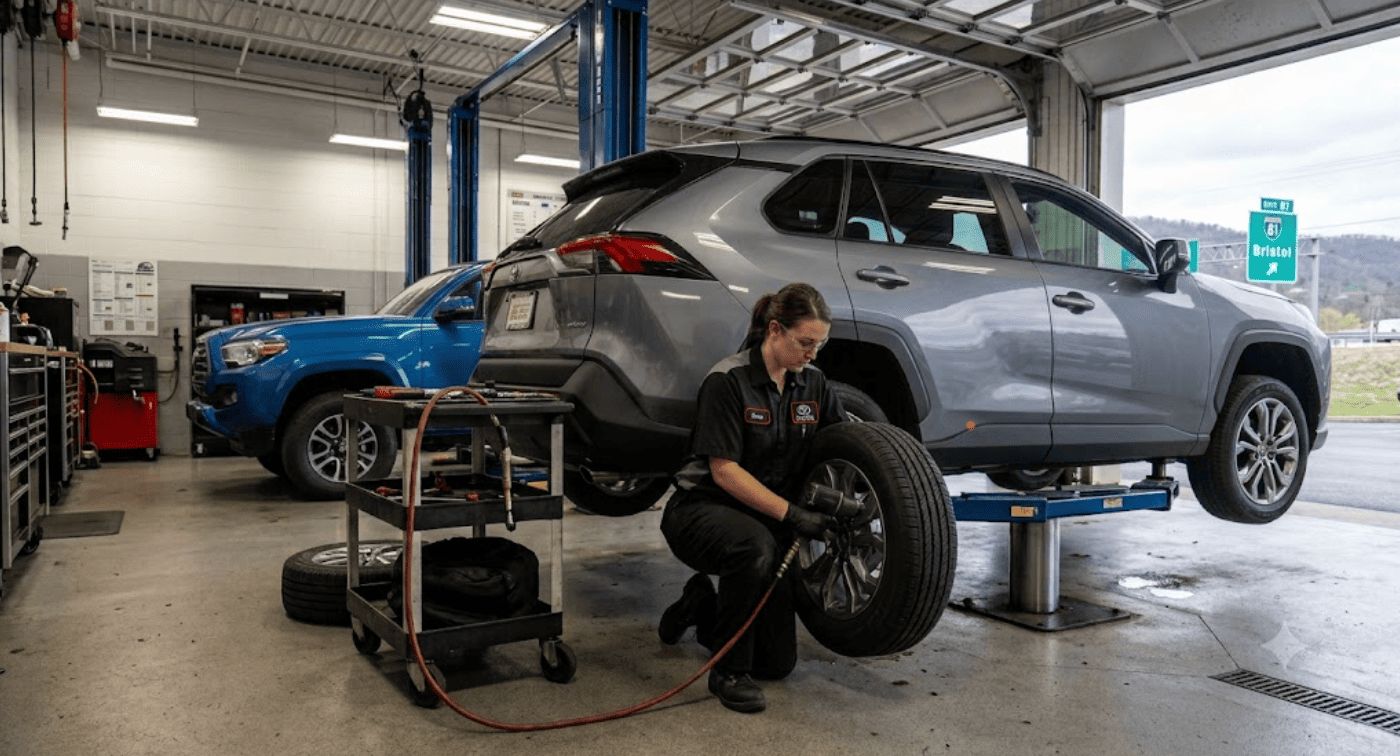
The 5,000 to 7,500-Mile Rotation Range and Owner’s Manual Guidance
The safest tire rotation answer starts with the owner’s manual because Toyota models, tire types, wheel sizes, and drivetrain layouts can vary. As a general service guide, Toyota maintenance material commonly places tire rotation around every 5,000 to 7,500 miles. We recommend treating that range as a planning window, then confirming the exact interval and pattern for your Toyota.
For a Bristol daily commuter who drives I-81 regularly, the 5,000 to 7,500-mile range is a practical reminder because highway miles, lane changes, braking, and road-surface changes can create uneven wear over time. Our service team advises checking tire pressure and tread condition during the same visit because rotation works best when the tires are also properly inflated and inspected.
Based on our experience at Toyota of Bristol, tire rotation should not be treated as a random add-on. We recommend rotating Toyota tires according to the owner’s manual, watching the 5,000 to 7,500-mile service window, and scheduling sooner if you see uneven wear, vibration, pulling, or pressure loss.
- Check your owner’s manual for your Toyota model’s rotation interval and pattern.
- Use 5,000 to 7,500 miles as a common planning range unless your Toyota specifies otherwise.
- Schedule sooner if tread wear looks uneven or the vehicle vibrates.
- Check tire pressure during every rotation visit.
- Ask about alignment if the Toyota pulls, drifts, or wears one side faster.
| Rotation Planning Factor | Typical Guidance | Why It Matters | Ideal Use Case |
|---|---|---|---|
| Owner’s manual | Primary source for interval and pattern | Different Toyota models and tire setups can vary | Any Toyota owner checking exact guidance |
| General mileage range | Often around 5,000 to 7,500 miles | Helps drivers plan routine service | Bristol commuter tracking mileage |
| Severe or frequent use | May require earlier inspection | Loads, hills, traffic, and rough roads can change wear | Blountville truck owner carrying tools |
| AWD models | Pattern should follow Toyota guidance | Even tire wear helps support drivetrain consistency | Abingdon AWD SUV driver |
| Warning signs | Inspect before waiting for mileage | Uneven wear, vibration, or pulling should not wait | Kingsport family driver noticing tire wear |
| Best For | Plan by mileage, confirm by inspection | Combines schedule with real tire condition | Tri-Cities Toyota service customer |
Based on Toyota official website.
Why Driving Habits and Tire Type Matter
Two Toyota drivers can own similar vehicles and still wear tires differently. A commuter who spends most of the week on I-81 may see a different wear pattern than a Johnson City family running short errands, school pickup, and weekend travel. A driver who parks on rough surfaces, turns tightly, brakes hard, or carries cargo regularly can also change the wear pattern.
Tire type matters too. All-season tires, performance-oriented tires, truck tires, SUV tires, and tires with different speed ratings or tread designs should be rotated according to the tire and vehicle guidance. Our tire center can help confirm what is installed on your Toyota before recommending the correct rotation path.
For a Johnson City road-tripper preparing for I-26 and I-81 summer travel, we recommend tire rotation, tire pressure check, tread-depth review, and a multi-point inspection before leaving. That service combination helps confirm that the tires are wearing evenly before the vehicle is loaded with passengers and luggage.
FWD, AWD, Trucks, SUVs, and Hybrids: Why Rotation Patterns Can Vary
Rotation pattern is not one-size-fits-all. Front-wheel-drive Toyota cars, AWD SUVs, trucks, hybrids, and models with directional tires can call for different handling. That is why we recommend following the owner’s manual instead of copying a generic pattern from another vehicle.
For an Abingdon AWD SUV driver who deals with hills, rain, and changing road surfaces, even tire wear is especially important. AWD vehicles can be sensitive to tire condition because the tires work together across the drivetrain. Our technicians can inspect tread depth across all four tires and confirm if rotation, alignment, or replacement guidance is the right next step.
We also see different needs between models like Camry, Corolla, RAV4, Highlander, Tacoma, Tundra, and Sienna. A commuter sedan, family SUV, and truck that carries regular weekend cargo should not be treated exactly the same. The vehicle, tires, and driver routine all matter.
Signs Your Toyota Tires Need Attention
Rotation vs Inspection vs Replacement Decision Table
Mileage is only one part of tire care. A Toyota can need tire attention before the regular rotation interval if the driver notices vibration, uneven tread, sidewall damage, or repeated pressure warnings. We recommend using the symptom to decide whether the next step is rotation, inspection, alignment review, or tire replacement guidance.
| Tire Concern | Likely Next Step | Why It Matters | Best For |
|---|---|---|---|
| No visible issue, mileage is due | Tire rotation | Helps even out tread wear | Bristol commuter tracking service intervals |
| Uneven front tire wear | Rotation plus tread-depth inspection | Wear pattern may show alignment or pressure concerns | Kingsport family driver |
| Vehicle pulls or steering wheel is off-center | Tire inspection and alignment review | Rotation alone may not solve pulling | I-81 commuter |
| Vibration at speed | Tire and wheel inspection | Could involve balance, tire damage, or wear | Johnson City road-tripper |
| Sidewall bulge, crack, or puncture | Prompt tire inspection | Visible damage should not wait for mileage | Any Toyota owner after road impact |
| Best For | Match service to tire condition | Prevents guessing and supports safer driving | Tri-Cities Toyota owner |
Based on Toyota official website.
The key difference between rotation and inspection is the question being answered. Rotation helps even out tire wear. Inspection tells us whether the tires, alignment, pressure, tread depth, or visible condition needs more attention. We recommend rotation when mileage is due and the tires look healthy, but we recommend inspection first when the Toyota vibrates, pulls, loses pressure, or shows unusual wear.
Use-Case Recommendations for Commuters, Families, AWD Drivers, and Road-Trippers
For a Bristol commuter who drives I-81 often, we recommend staying close to the regular rotation interval because steady mileage can build quickly. For a Kingsport family driver who notices uneven front tire wear during school and errand routines, we recommend tire rotation plus tread-depth inspection because the pattern may reveal more than normal use. For a Johnson City road-tripper preparing for summer travel, we recommend tire rotation, pressure check, and multi-point inspection before loading the vehicle.
- If you commute on I-81, we recommend tracking mileage closely because highway driving can add service miles faster than expected.
- If your Toyota is AWD, we recommend following the owner’s manual pattern because even tire wear matters across the drivetrain.
- If you carry tools, mulch, or weekend gear, we recommend inspection with rotation because extra load can influence wear.
- If you notice vibration, we recommend inspection before assuming rotation alone will fix it.
- If you are planning a road trip, we recommend tire rotation and pressure check before travel day.
Our service team can rotate your Toyota tires, inspect tread depth, check tire pressure, review wear patterns, and help decide if alignment or tire replacement guidance is needed. We recommend starting with our online service scheduler if your mileage interval is due or if you notice uneven wear. You can also call us at 423-764-3155 and describe what you are feeling, such as vibration, pulling, pressure loss, or road noise. Our tire center supports Toyota owners with tire service, replacement tire guidance, and service history documentation. We can also pair tire service with oil changes, brake checks, battery testing, or seasonal inspections when your Toyota is already in the service bay.
Why Tire Rotation Matters in the Tri-Cities
I-81, I-26, Mountain Roads, Rain, Potholes, and Local Driving Conditions
Local roads give tires a real workout. Bristol commuters may add mileage quickly on I-81. Johnson City drivers may split time between I-26, city streets, and family errands. Abingdon drivers may deal with hills, changing weather, and darker rural roads. Blountville truck owners may carry tools, mulch, outdoor gear, or weekend supplies. All of those patterns can affect tire wear.
For drivers in Bristol, Kingsport, Johnson City, Abingdon, and nearby Tri-Cities communities, we recommend treating tire rotation as local road preparation, not just a mileage task. Rain, potholes, mountain grades, highway speeds, and short-trip braking can all influence how quickly tires show uneven wear. A quick rotation and inspection can help catch problems before a long commute or family trip.
| Local Condition | Tire-Wear Concern | Driver Profile | Recommended Service Step |
|---|---|---|---|
| Bristol I-81 commuting | Mileage builds quickly | Daily commuter | Track mileage and rotate on schedule |
| Kingsport school and errand driving | Frequent braking and turning | Family driver | Rotate and inspect front tire wear |
| Johnson City I-26 travel | Highway speed plus trip loads | Road-tripper | Rotation, pressure check, and multi-point inspection |
| Abingdon hills and rain | Traction and wear pattern changes | AWD SUV driver | Follow Toyota rotation pattern and inspect tread depth |
| Blountville cargo use | Load-related tire wear | Truck or SUV owner | Inspect tread and pressure during rotation |
| Best For | Local service planning | Tri-Cities Toyota owner | Match tire service to real driving conditions |
Based on Toyota official website.
We invite drivers from Bristol, Kingsport, Johnson City, Abingdon, Blountville, and Elizabethton to use our tire center when rotation timing, tire pressure, tread wear, or road-trip preparation is on your mind. We can rotate tires, inspect wear patterns, check pressure, review alignment symptoms, and help you compare tire replacement options when needed. We also support ownership through the Toyota of Bristol Advantage Plan, and eligible ToyotaCare service can help keep routine maintenance organized. Visit us at 3045 W State St, Bristol, TN 37620, start with our Toyota Tire Center, or call 423-764-3155 with your tire concern. We will help you choose the right tire service step for your Toyota and your local driving routine.
Local Driving Insight: How Bristol Roads Can Change Tire Wear
Tire wear is not only about mileage. It is also about how the Toyota is used. A RAV4 that spends the week on highway commutes may wear differently than a Tacoma carrying weekend supplies. A Camry used for daily errands may show different front-tire wear than a Highlander used for family trips across Southwest Virginia. Our technicians look at those patterns during tire service.
For a Blountville truck owner who carries tools, mulch, or outdoor gear, we recommend tire inspection with rotation because added load can change wear. For an Abingdon AWD SUV driver, we recommend monitoring tread depth across all four tires because traction confidence depends on consistent tire condition. For an Elizabethton owner trying to make tires last longer, we recommend regular rotation, pressure checks, and alignment awareness.
The most useful tire appointment starts with information. Tell us your mileage, where you drive most, whether you hear road noise, whether the Toyota pulls, and whether the tire-pressure warning has appeared. Those details help our service team connect the wear pattern to your driving routine.
Ownership Cost Analysis: Why Tire Rotation Is Cheaper Than Ignoring Tire Wear
We do not need to use exact pricing to make the value point clear. Ignoring tire rotation can allow uneven wear to build until the tire set loses usable life. Rotation cannot fix a damaged tire or solve a serious alignment problem by itself, but it can help spread normal wear more evenly when performed on schedule.
For an Elizabethton budget-conscious owner, we recommend regular rotation because tires are a major ownership item. For a Johnson City family planning summer trips, we recommend pairing rotation with pressure checks and tread inspection. For a Bristol commuter, we recommend making tire rotation part of the same service rhythm as oil changes and multi-point inspections when timing lines up.
- If the tires are healthy, rotation helps even out normal wear.
- If wear is uneven, inspection helps identify alignment, pressure, or driving-pattern concerns.
- If the Toyota pulls or vibrates, diagnosis should come before assuming rotation is enough.
- If a road trip is coming, tire service helps confirm tread and pressure before travel.
- If tire replacement is needed, our tire center can help match tire options to your Toyota.
We also recommend keeping tire-service records. ToyotaCare, when applicable, can help organize early factory-scheduled maintenance, and our service history can help future visits start with better information.
Key Takeaways
- Check your Toyota owner’s manual for the exact tire rotation interval and pattern.
- Many Toyota maintenance references place rotation around 5,000 to 7,500 miles.
- Uneven wear, vibration, pulling, or pressure loss should be inspected before waiting for mileage.
- I-81 commuting, hills, rain, and cargo use can affect tire wear around Bristol.
- Regular rotation helps support tire life, handling, traction, and ride comfort.
Toyota Tire Rotation FAQ for Bristol Drivers
How often should Toyota tires be rotated?
Most Toyota owners should check the owner’s manual for the exact tire rotation interval, but many Toyota maintenance references place tire rotation around every 5,000 to 7,500 miles. We recommend using that range as a planning reminder, then confirming the correct interval and pattern for your Toyota. For a Bristol commuter who drives I-81 frequently, tracking mileage closely helps keep tire service from slipping past the ideal window.
Do AWD Toyota vehicles need tire rotation?
AWD Toyota vehicles still need tire rotation, and we recommend following the owner’s manual pattern for the exact model and tire setup. Even wear matters because all four tires work together across the drivetrain. For an Abingdon driver with a RAV4 AWD, Highlander AWD, or another AWD Toyota, we recommend checking tread depth across all four tires during service rather than assuming every tire is wearing the same way.
What signs mean my Toyota tires need attention?
Your Toyota tires need attention if you notice uneven tread wear, vibration, pulling, road noise, repeated pressure warnings, sidewall damage, or a puncture. We recommend inspection before waiting for the next mileage interval when any of those symptoms appear. A Kingsport family driver who notices front tire wear during school and errand driving should schedule a tire inspection because the issue may involve pressure, alignment, or rotation timing.
Can Toyota of Bristol rotate and inspect my tires?
Our service center can rotate Toyota tires, inspect tread depth, check tire pressure, review wear patterns, and help with tire replacement guidance when needed. We recommend scheduling online or calling 423-764-3155 if your tire rotation interval is due or if you notice uneven wear, vibration, pulling, or pressure loss. We serve Bristol, Kingsport, Johnson City, Abingdon, Blountville, Elizabethton, and nearby Tri-Cities communities.
Schedule Tire Service at Toyota of Bristol
We are here to help your Toyota feel ready for Bristol commutes, Tri-Cities errands, mountain roads, rain, and summer travel. Visit us at 3045 W State St, Bristol, TN 37620, or call 423-764-3155 so our service team can rotate your tires, inspect tread, check pressure, and review wear patterns. We support drivers from Bristol, Kingsport, Johnson City, Abingdon, Blountville, and Elizabethton. Our Toyota of Bristol Advantage Plan and ToyotaCare support help keep ownership easier after the sale. Schedule tire service online when your mileage interval is due or when your Toyota shows tire-wear warning signs.
Related Articles
Keep reading more Toyota service guides, safety tips, and seasonal ownership advice from Toyota of Bristol.
Battery Guide
A Step-by-Step Toyota Jumpstart Guide
Use this Toyota battery guide for safe jumpstart steps, hybrid 12V reminders, and service advice after a no-start.
Safety Guide
Is a Cracked Windshield Dangerous? Here’s Why You Shouldn’t Ignore It
See why windshield damage can affect visibility, vehicle structure, and Toyota safety-system confidence.
Seasonal Service
Spring Car Cleaning and Service Tips in Bristol
Freshen your Toyota with filter checks, glass cleaning, tire rotation reminders, and simple seasonal service tips.


