
Blog / Bristol Toyota Dealer

2026 Toyota RAV4 XLE vs XSE: Which Trim Fits Bristol Drivers?

RAV4_XLE_vs_XSE

Choose the 2026 Toyota RAV4 XLE if you want a practical, comfort-focused RAV4 with strong value for commuting, errands, and family use. Choose the 2026 Toyota RAV4 XSE if you want a sportier look, a more feature-forward feel, and a trim that stands out visually while keeping RAV4 practicality. Toyota of Bristol helps local shoppers compare both trims by daily route, seating needs, cargo use, design preference, and available drivetrain. For a Bristol commuter who wants comfort and value, we usually start with XLE; for a Kingsport driver who wants a sharper style and more premium daily feel, we usually start with XSE.

This comparison stays focused on XLE versus XSE, not every RAV4 grade. That matters because the redesigned 2026 RAV4 lineup includes electrified powertrain choices and multiple style groups, so a trim decision should be practical and specific. Our goal is to help you understand what changes between XLE and XSE, what those differences feel like in daily use, and which one fits Bristol-area driving better.

We will compare features, style, comfort, commuting, family use, long-term value, and local driving conditions across Bristol, Kingsport, Johnson City, Abingdon, Blountville, Elizabethton, and the Tri-Cities.

Definition: A 2026 RAV4 XLE vs XSE comparison is a trim-level decision between a comfort-focused RAV4 grade and a sport-focused RAV4 grade. It helps drivers compare design, features, powertrain context, daily comfort, technology, and value for commuting, family driving, and local travel.

2026 RAV4 XLE vs XSE at a Glance

Key Takeaway: XLE is the better starting point for value-focused comfort, while XSE is the better fit for drivers who want sportier design, stronger visual presence, and a more expressive RAV4 experience.

Feature, Style, and Value Differences

The biggest difference between the 2026 RAV4 XLE and XSE is personality. XLE is designed for shoppers who want a well-equipped RAV4 without jumping straight into a sport-focused look. XSE is designed for shoppers who want a more expressive RAV4 with sharper visual attitude and a more upscale daily feel. We recommend deciding first by how much you value comfort and practicality versus sportier styling.

For 2026, Toyota positions RAV4 with Core, Rugged, and Sport styles. XLE sits in the practical comfort conversation, while XSE belongs in the sportier shopper conversation. Exact features, powertrain availability, drivetrain, packages, and inventory can vary, so we recommend checking the window sticker on the exact RAV4 you are considering.

Based on our experience at Toyota of Bristol, the 2026 RAV4 XLE is the better fit for a Bristol daily commuter who wants a balanced SUV for work, groceries, and weekend drives. The 2026 RAV4 XSE is the better fit for a Kingsport young professional who wants the same RAV4 usefulness with a more stylish presence. The choice is not about good versus bad; it is about whether value or sport style matters more every day.

  • Choose XLE if you want comfort, value, and an easy everyday fit.
  • Choose XSE if you want sportier design and a more distinctive RAV4 feel.
  • Choose XLE if you want to stay focused on practical features and payment fit.
  • Choose XSE if you want your RAV4 to feel more personal and visually upgraded.
  • Compare exact vehicles because availability can vary by grade, package, and inventory timing.
Comparison Point2026 Toyota RAV4 XLE2026 Toyota RAV4 XSEBest For
Main personalityComfort-focused and value-mindedSport-focused and more expressiveXLE for practical buyers; XSE for style-focused drivers
Design feelClean, approachable, everyday-friendlySharper, sportier, more visually distinctiveXSE for shoppers who care about appearance
Daily valueStrong fit for comfort and payment balanceBetter fit if added style and features feel worth itXLE for budget focus; XSE for daily enjoyment
Buyer mindsetPractical, family-minded, commute-focusedSport-style, tech-minded, long-term enjoymentChoose by how you want the SUV to feel
Inventory checkConfirm exact equipment and drivetrainConfirm exact equipment and drivetrainBoth require exact-vehicle review
Ideal Use CaseBristol commuter or family shopperKingsport driver who wants stronger styleMatch trim to daily routine

Based on Toyota official website.

Powertrain, Efficiency, and Drivetrain Availability

The 2026 RAV4 moves into a fully electrified direction. Toyota confirms the redesigned RAV4 offers HEV or PHEV powertrains depending on grade, with available FWD or AWD depending on grade. That is important for XLE versus XSE shoppers because the powertrain conversation should be tied to the exact RAV4 you are comparing, not a generic assumption.

For an Abingdon seasonal-weather driver dealing with hills, summer rain, and changing mountain roads, we recommend confirming the drivetrain on the exact RAV4 XLE or XSE. Available AWD can matter for confidence, but availability depends on grade and vehicle configuration. For a Bristol commuter, efficiency and total daily comfort may carry more weight than choosing the sportiest trim.

Our team can help you compare the window sticker, drivetrain, hybrid or plug-in hybrid configuration, charging needs if applicable, Toyota Safety Sense features, and equipment before you make the final call. We recommend reviewing the actual vehicle because Toyota’s official details can vary by grade and timing.

Interior Comfort, Technology, and Daily Use

Interior decisions usually become clear when a shopper sits in both trims. XLE gives the practical RAV4 experience many drivers want: comfortable seating, flexible cargo use, modern Toyota controls, and an easy daily rhythm. XSE adds a more expressive feel that can make the vehicle more enjoyable for drivers who care about design and a richer cabin impression.

For a Johnson City family of four, we recommend comparing both trims with daily cargo in mind. Bring the stroller, sports bag, backpack, pet crate, or cooler if that helps. The RAV4 shape is naturally useful, but the right trim depends on how much you want added style and feature content versus keeping the choice more value-focused.

For Elizabethton long-term owners who plan to keep the SUV for years, XSE can make sense if the sport styling and added daily enjoyment still feel worth it after the first test drive. For Blountville budget-conscious shoppers, XLE may be the better match because it keeps the RAV4 decision grounded in practical ownership.

Which RAV4 Trim Is Better for Commuting?

Key Takeaway: XLE is usually the better commuter value, while XSE is the stronger commuter choice for drivers who want their daily SUV to feel sportier, sharper, and more personal.

XLE vs XSE Commuter Comparison Table

A commuter RAV4 should feel comfortable, efficient, easy to use, and worth the monthly payment. That is why we recommend comparing XLE and XSE by daily benefit, not only by trim name. The right choice depends on how much you care about commute comfort, highway feel, design, and long-term satisfaction.

Commuter Need2026 RAV4 XLE2026 RAV4 XSEBest For
Payment-conscious commutingBetter starting point for valueWorth comparing if added features matterXLE for budget-focused drivers
Daily comfortStrong comfort and practical useComfort plus sportier feelXLE for straightforward comfort
Highway personalityCalm, balanced RAV4 feelMore expressive RAV4 characterXSE for drivers who want more style
Fuel and drivetrain reviewConfirm exact HEV, drivetrain, and equipmentConfirm exact HEV or PHEV context where applicableBoth require exact-vehicle review
After-work errandsPractical for groceries and daily cargoSame RAV4 usefulness with stronger design appealXLE for function; XSE for function plus flair
Ideal Use CaseBristol commuter who wants value and comfortKingsport commuter who wants a sportier daily SUVChoose by commute style and payment fit

Based on Toyota official website.

The commuter verdict is clear: we recommend XLE for drivers who want the most sensible RAV4 fit for daily comfort, work trips, errands, and payment discipline. We recommend XSE for drivers who want their commute to feel more distinctive and are willing to prioritize sport design and a more expressive trim. For Bristol-area drivers, the better trim is the one you still like after a normal weekday drive, not only after reading the feature list.

Use-Case Recommendations for I-81, I-26, and Daily Bristol Driving

For a Bristol daily commuter using I-81 several days a week, we recommend starting with XLE because comfort, value, and everyday ease usually matter most. For a Kingsport young professional who wants a more expressive SUV for work, errands, and weekend plans, we recommend test driving XSE because the sportier look may be worth the upgrade. For an Abingdon driver facing rain, hills, and changing roads, we recommend confirming exact drivetrain availability on the specific XLE or XSE.

  • If you commute on I-81 and want value, we recommend XLE because it keeps the decision practical.
  • If you want a sportier Toyota SUV for daily use, we recommend XSE because design may matter every time you walk up to it.
  • If your commute includes I-26 or longer Tri-Cities drives, we recommend comparing exact drivetrain and comfort features.
  • If you carry family cargo after work, we recommend checking cargo access and rear-seat space in both trims.
  • If you are choosing a long-term SUV, we recommend test driving both before deciding on price alone.

Our sales team can help you compare the 2026 RAV4 XLE and XSE side by side so the decision feels specific to your routine. We can review current inventory, window stickers, drivetrain availability, packages, interior details, and Toyota Safety Sense features on the exact vehicles available. Start with our new Toyota inventory, or call 423-764-3155 and tell us which RAV4 trims you are comparing. We can also help you schedule a test drive that includes the types of roads you use most often. We recommend bringing your commute, cargo needs, and budget into the conversation so we can guide you toward the trim that fits cleanly.

Which RAV4 Trim Is Better for Families?

Key Takeaway: XLE is usually the better family value trim, while XSE can make sense for families who want the same RAV4 usefulness with a stronger style and feature feel.

Cargo, Rear-Seat Comfort, Safety Tech, and Local Family Use

Families usually compare RAV4 trims differently than solo commuters. The question becomes how the SUV handles school bags, groceries, child seats, sports gear, pets, weekend luggage, and longer drives between Bristol, Johnson City, Kingsport, and Abingdon. Both XLE and XSE keep the core RAV4 usefulness, but the reason to choose one over the other changes by household.

For a Johnson City family of four, we recommend starting with XLE if the priority is comfort, practical features, and a smart monthly payment. We recommend comparing XSE if the family plans to keep the SUV for years and wants a more stylish daily experience. For an Abingdon seasonal-weather driver, we recommend reviewing exact drivetrain availability and tires on the vehicle being considered.

Family Scenario2026 RAV4 XLE Recommendation2026 RAV4 XSE RecommendationBest For
Family of fourStrong value and practical comfortWorth it if style and features matterXLE for value; XSE for upgraded daily feel
School and sports gearPractical RAV4 cargo fitSame basic SUV utility with stronger designXLE for practical family use
Weekend road tripsComfortable and budget-consciousMore enjoyable if you value the sport trim feelXSE for long-term enjoyment
Pet and grocery routinesSmart everyday RAV4 choiceBetter if design matters as much as utilityXLE for Blountville pet owners on a budget
Growing householdKeeps the purchase groundedBetter if you want the nicer-feeling trim for yearsChoose by budget and ownership length
Ideal Use CaseFamily wants value, comfort, and flexibilityFamily wants style, features, and personalityMatch trim to household priorities

Based on Toyota official website.

For families in Bristol and the Tri-Cities, the XLE versus XSE choice should be made with real cargo in mind. Bring the stroller, sports bag, pet crate, cooler, or backpack pile if that helps. We can show you seating access, cargo loading, rear visibility, Toyota Safety Sense features, and current RAV4 inventory. We also support your ownership through the Toyota of Bristol Advantage Plan, so the relationship does not stop after the sale. Visit us at 3045 W State St, Bristol, TN 37620, start with our 2026 RAV4 information, or call 423-764-3155 with the family routine you need the vehicle to handle.

Trim-Level Deep Dive: When the XSE Upgrade Makes Sense

Key Takeaway: The XSE upgrade makes the most sense when a shopper wants RAV4 practicality plus a sportier design identity that feels better every day.

The XSE is the right RAV4 conversation when design and daily enjoyment matter as much as function. Some shoppers want the most practical trim that fits the budget. Others want a RAV4 that feels more personal, more expressive, and more visually distinct. XSE is for that second buyer.

For an Elizabethton long-term owner who plans to keep the SUV for years, we recommend considering XSE if the styling, trim feel, and feature mix make the vehicle more enjoyable every day. That matters because an SUV is not only a spreadsheet decision. You see it in the driveway, sit in it every morning, and use it for every part of your routine.

  • If you care about sport-inspired styling, XSE should be on your list.
  • If you want more personality from your daily SUV, XSE may be worth the upgrade.
  • If your budget is firm, compare XLE first before adding features.
  • If you plan to keep the RAV4 for years, consider which trim you will still enjoy later.

We recommend test driving XSE after driving XLE. That sequence makes the upgrade easier to judge because you can feel whether the sportier trim changes the experience enough for your budget.

Ownership Cost Analysis: Why XLE May Be the Smarter Value Play

Key Takeaway: XLE may be the smarter value play when the shopper wants RAV4 comfort, safety, cargo practicality, and Toyota ownership support without paying mainly for sport-style upgrades.

XLE makes sense because many RAV4 shoppers are not chasing the most expressive trim. They want a Toyota SUV that feels comfortable, efficient, versatile, and financially sensible. We recommend XLE for shoppers who want to keep the purchase grounded in daily use rather than emotional upgrades.

For a Blountville budget-conscious shopper, XLE can be the better fit because it keeps the RAV4 decision focused on the essentials: comfort, utility, safety tech, cargo flexibility, and payment confidence. For a Bristol commuter with predictable routes, XLE may provide the practical RAV4 experience without stepping into a trim that emphasizes style more heavily.

  • If monthly payment matters most, compare XLE first.
  • If you care more about comfort than sport style, XLE is the cleaner fit.
  • If you want more visual personality, compare XSE before deciding.
  • If you need financing support, our team can review options with your budget in mind.
  • If you are unsure, drive both trims before choosing from numbers alone.

Key Takeaways

  • The 2026 RAV4 XLE is the stronger choice for comfort, value, family practicality, and daily commuting.
  • The 2026 RAV4 XSE is the stronger choice for sportier design, trim personality, and long-term daily enjoyment.
  • Toyota confirms the 2026 RAV4 offers HEV or PHEV powertrains depending on grade.
  • Exact drivetrain, features, and packages should be verified on the specific RAV4 you compare.
  • Bristol commuters should start with XLE, while style-focused drivers should compare XSE in person.

2026 Toyota RAV4 XLE vs XSE FAQ for Bristol Shoppers

What is the biggest difference between the 2026 RAV4 XLE and XSE?

The biggest difference is trim personality. We recommend the 2026 RAV4 XLE for shoppers who want comfort, value, and practical daily use. We recommend the 2026 RAV4 XSE for shoppers who want a sportier design and a more distinctive RAV4 feel. Exact equipment, drivetrain, packages, and availability should be confirmed on the specific vehicle because Toyota’s 2026 RAV4 details can vary by grade and configuration.

Is the 2026 RAV4 XSE worth it over the XLE?

The 2026 RAV4 XSE is worth comparing if sportier styling, feature feel, and daily enjoyment matter enough to justify the upgrade. For a Kingsport driver who wants the RAV4 to feel more personal every day, we recommend test driving XSE. For a Bristol commuter who wants strong value and straightforward comfort, we recommend starting with XLE before moving up.

Which 2026 RAV4 trim is better for families?

The 2026 RAV4 XLE is usually the better family value trim because it keeps the decision practical while still giving RAV4 flexibility. XSE can still make sense for families who want the same core SUV usefulness with a sportier look and richer daily feel. For Johnson City families carrying sports bags, groceries, pets, and weekend gear, we recommend comparing both trims in person with real cargo needs in mind.

Which RAV4 trim should Bristol commuters choose?

Bristol commuters should start with the 2026 RAV4 XLE if value, comfort, and predictable daily driving matter most. XSE is the better commuter choice if the driver wants a sportier RAV4 and expects the added design personality to matter every day. We recommend driving both trims on a route similar to your commute before deciding.

Shop the 2026 Toyota RAV4 at Toyota of Bristol

We are here to help you choose the 2026 RAV4 trim that fits your commute, family, budget, and driving personality. Visit us at 3045 W State St, Bristol, TN 37620, or call 423-764-3155 so we can compare XLE and XSE with your daily routine in mind. We serve drivers from Bristol, Kingsport, Johnson City, Abingdon, Blountville, Elizabethton, and nearby Tri-Cities communities. Our Toyota of Bristol Advantage Plan helps support ownership after the sale, and our team can help with inventory, test drives, and financing next steps. Tell us how you drive, and we will help you choose the RAV4 trim that fits.

Related Articles

Keep reading more Toyota model comparisons, SUV shopping guides, and ownership tips from Toyota of Bristol.

New

2026 Toyota Sienna Hybrid: The Minivan Bristol Families Have Been Waiting For

The 2026 Toyota Sienna Hybrid is a family minivan with a standard hybrid powertrain, flexible seating, sliding side doors, and available all-wheel drive.

Read More

New

A Step-by-Step Toyota Jumpstart Guide

A safe Toyota jumpstart starts with inspection, correct cable order, a secure ground point, and a service follow-up if the battery problem repeats.

Read More

Service Guide

Toyota A/C Service in Bristol, TN: Summer Cooling Guide

Review weak airflow signs, cabin air filter guidance, and summer service timing for Bristol and Tri-Cities drivers.
Read More

Posted in:

Related Posts

rotate_tire_toyota_

How Often Should You Rotate Toyota Tires in Bristol, TN?

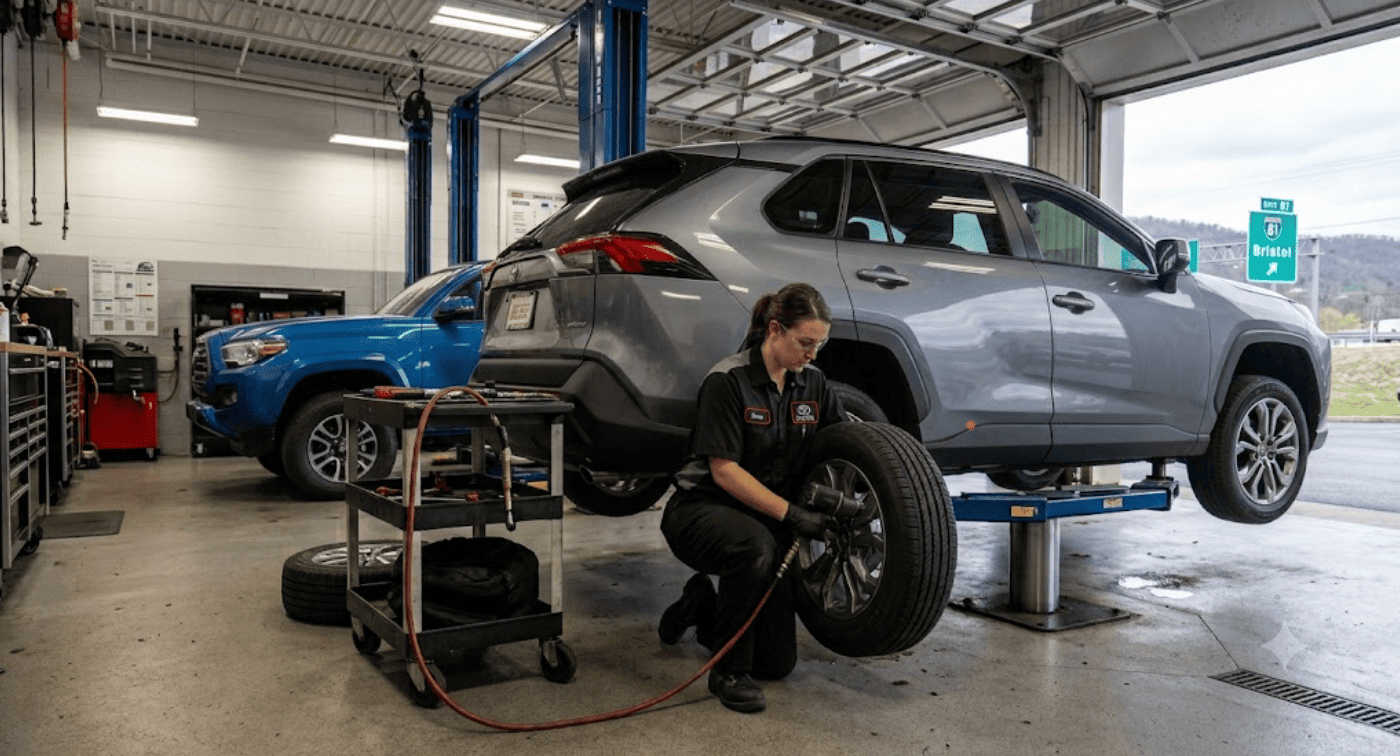
Most Toyota owners should check the owner’s manual for the exact tire rotation interval and rotation pattern, but Toyota maintenance guidance commonly places tire rotation around every 5,000 to 7,500 miles depending on model, tire type, driving habits, and road conditions. Toyota of Bristol helps local drivers match that guidance to real Bristol driving, including I-81 commuting, I-26 travel, mountain roads, rain, and mixed city traffic. For a Bristol commuter who drives I-81 several days a week, we recommend tracking mileage and scheduling tire rotation before uneven wear becomes visible. Tire rotation matters because tires do not all wear at the same rate. Front tires, rear tires, all-wheel-drive tires, truck tires, and tires on vehicles carrying regular cargo can all wear differently. Our service team looks at tread depth, tire pressure, tire age, alignment symptoms, vibration, and driving pattern before recommending the next step. This guide explains general Toyota tire rotation timing, warning signs, local Tri-Cities driving conditions, and how our tire center can help you schedule rotation, tire inspection, alignment support, or tire replacement guidance when needed. Definition: Tire rotation is the process of moving tires to different wheel positions to help even out tread wear. It is designed to support tire life, handling, traction, and ride comfort for drivers in Bristol, Kingsport, Johnson City, Abingdon, and nearby Tri-Cities communities. Schedule Tire Rotation Table of Contents General Toyota Tire Rotation Guidance The 5,000 to 7,500-Mile Rotation Range and Owner’s Manual Guidance Why Driving Habits and Tire Type Matter FWD, AWD, Trucks, SUVs, and Hybrids: Why Rotation Patterns Can Vary Signs Your Toyota Tires Need Attention Rotation vs Inspection vs Replacement Decision Table Use-Case Recommendations for Commuters, Families, AWD Drivers, and Road-Trippers Why Tire Rotation Matters in the Tri-Cities I-81, I-26, Mountain Roads, Rain, Potholes, and Local Driving Conditions Local Driving Insight: How Bristol Roads Can Change Tire Wear Ownership Cost Analysis: Why Tire Rotation Is Cheaper Than Ignoring Tire Wear Key Takeaways Toyota Tire Rotation FAQ for Bristol Drivers How often should Toyota tires be rotated? Do AWD Toyota vehicles need tire rotation? What signs mean my Toyota tires need attention? Can Toyota of Bristol rotate and inspect my tires? Schedule Tire Service at Toyota of Bristol General Toyota Tire Rotation Guidance Key Takeaway: Toyota tire rotation timing should start with the owner’s manual, but many Toyota maintenance schedules place rotation in the 5,000 to 7,500-mile range depending on tire type, drivetrain, and driving conditions. Visit Our Toyota Tire Center The 5,000 to 7,500-Mile Rotation Range and Owner’s Manual Guidance The safest tire rotation answer starts with the owner’s manual because Toyota models, tire types, wheel sizes, and drivetrain layouts can vary. As a general service guide, Toyota maintenance material commonly places tire rotation around every 5,000 to 7,500 miles. We recommend treating that range as a planning window, then confirming the exact interval and pattern for your Toyota. For a Bristol daily commuter who drives I-81 regularly, the 5,000 to 7,500-mile range is a practical reminder because highway miles, lane changes, braking, and road-surface changes can create uneven wear over time. Our service team advises checking tire pressure and tread condition during the same visit because rotation works best when the tires are also properly inflated and inspected. Based on our experience at Toyota of Bristol, tire rotation should not be treated as a random add-on. We recommend rotating Toyota tires according to the owner’s manual, watching the 5,000 to 7,500-mile service window, and scheduling sooner if you see uneven wear, vibration, pulling, or pressure loss. Check your owner’s manual for your Toyota model’s rotation interval and pattern. Use 5,000 to 7,500 miles as a common planning range unless your Toyota specifies otherwise. Schedule sooner if tread wear looks uneven or the vehicle vibrates. Check tire pressure during every rotation visit. Ask about alignment if the Toyota pulls, drifts, or wears one side faster. Rotation Planning Factor Typical Guidance Why It Matters Ideal Use Case Owner’s manual Primary source for interval and pattern Different Toyota models and tire setups can vary Any Toyota owner checking exact guidance General mileage range Often around 5,000 to 7,500 miles Helps drivers plan routine service Bristol commuter tracking mileage Severe or frequent use May require earlier inspection Loads, hills, traffic, and rough roads can change wear Blountville truck owner carrying tools AWD models Pattern should follow Toyota guidance Even tire wear helps support drivetrain consistency Abingdon AWD SUV driver Warning signs Inspect before waiting for mileage Uneven wear, vibration, or pulling should not wait Kingsport family driver noticing tire wear Best For Plan by mileage, confirm by inspection Combines schedule with real tire condition Tri-Cities Toyota service customer Based on Toyota official website. Book Tire Service Online Why Driving Habits and Tire Type Matter Two Toyota drivers can own similar vehicles and still wear tires differently. A commuter who spends most of the week on I-81 may see a different wear pattern than a Johnson City family running short errands, school pickup, and weekend travel. A driver who parks on rough surfaces, turns tightly, brakes hard, or carries cargo regularly can also change the wear pattern. Tire type matters too. All-season tires, performance-oriented tires, truck tires, SUV tires, and tires with different speed ratings or tread designs should be rotated according to the tire and vehicle guidance. Our tire center can help confirm what is installed on your Toyota before recommending the correct rotation path. For a Johnson City road-tripper preparing for I-26 and I-81 summer travel, we recommend tire rotation, tire pressure check, tread-depth review, and a multi-point inspection before leaving. That service combination helps confirm that the tires are wearing evenly before the vehicle is loaded with passengers and luggage. FWD, AWD, Trucks, SUVs, and Hybrids: Why Rotation Patterns Can Vary Rotation pattern is not one-size-fits-all. Front-wheel-drive Toyota cars, AWD SUVs, trucks, hybrids, and models with directional tires can call for different handling. That is why we recommend following the owner’s manual instead of copying a generic pattern from another vehicle. For an Abingdon AWD SUV driver who deals with hills, rain, and changing road surfaces, even tire wear is especially important. AWD vehicles can be sensitive to tire condition because the tires work together across the drivetrain. Our technicians can inspect tread depth across all four tires and confirm if rotation, alignment, or replacement guidance is the right next step. We also see different needs between models like Camry, Corolla, RAV4, Highlander, Tacoma, Tundra, and Sienna. A commuter sedan, family SUV, and truck that carries regular weekend cargo should not be treated exactly the same. The vehicle, tires, and driver routine all matter. Signs Your Toyota Tires Need Attention Key Takeaway: Uneven tread wear, vibration, pulling, pressure loss, visible damage, or road noise means your Toyota tires should be inspected even if the mileage interval has not arrived yet. Rotation vs Inspection vs Replacement Decision Table Mileage is only one part of tire care. A Toyota can need tire attention before the regular rotation interval if the driver notices vibration, uneven tread, sidewall damage, or repeated pressure warnings. We recommend using the symptom to decide whether the next step is rotation, inspection, alignment review, or tire replacement guidance. Tire Concern Likely Next Step Why It Matters Best For No visible issue, mileage is due Tire rotation Helps even out tread wear Bristol commuter tracking service intervals Uneven front tire wear Rotation plus tread-depth inspection Wear pattern may show alignment or pressure concerns Kingsport family driver Vehicle pulls or steering wheel is off-center Tire inspection and alignment review Rotation alone may not solve pulling I-81 commuter Vibration at speed Tire and wheel inspection Could involve balance, tire damage, or wear Johnson City road-tripper Sidewall bulge, crack, or puncture Prompt tire inspection Visible damage should not wait for mileage Any Toyota owner after road impact Best For Match service to tire condition Prevents guessing and supports safer driving Tri-Cities Toyota owner Based on Toyota official website. The key difference between rotation and inspection is the question being answered. Rotation helps even out tire wear. Inspection tells us whether the tires, alignment, pressure, tread depth, or visible condition needs more attention. We recommend rotation when mileage is due and the tires look healthy, but we recommend inspection first when the Toyota vibrates, pulls, loses pressure, or shows unusual wear. Use-Case Recommendations for Commuters, Families, AWD Drivers, and Road-Trippers For a Bristol commuter who drives I-81 often, we recommend staying close to the regular rotation interval because steady mileage can build quickly. For a Kingsport family driver who notices uneven front tire wear during school and errand routines, we recommend tire rotation plus tread-depth inspection because the pattern may reveal more than normal use. For a Johnson City road-tripper preparing for summer travel, we recommend tire rotation, pressure check, and multi-point inspection before loading the vehicle. If you commute on I-81, we recommend tracking mileage closely because highway driving can add service miles faster than expected. If your Toyota is AWD, we recommend following the owner’s manual pattern because even tire wear matters across the drivetrain. If you carry tools, mulch, or weekend gear, we recommend inspection with rotation because extra load can influence wear. If you notice vibration, we recommend inspection before assuming rotation alone will fix it. If you are planning a road trip, we recommend tire rotation and pressure check before travel day. Our service team can rotate your Toyota tires, inspect tread depth, check tire pressure, review wear patterns, and help decide if alignment or tire replacement guidance is needed. We recommend starting with our online service scheduler if your mileage interval is due or if you notice uneven wear. You can also call us at 423-764-3155 and describe what you are feeling, such as vibration, pulling, pressure loss, or road noise. Our tire center supports Toyota owners with tire service, replacement tire guidance, and service history documentation. We can also pair tire service with oil changes, brake checks, battery testing, or seasonal inspections when your Toyota is already in the service bay. Check Tire Service Options Why Tire Rotation Matters in the Tri-Cities Key Takeaway: Bristol-area tire wear can be shaped by I-81 commuting, I-26 travel, mountain roads, rain, potholes, and short-trip driving across the Tri-Cities. I-81, I-26, Mountain Roads, Rain, Potholes, and Local Driving Conditions Local roads give tires a real workout. Bristol commuters may add mileage quickly on I-81. Johnson City drivers may split time between I-26, city streets, and family errands. Abingdon drivers may deal with hills, changing weather, and darker rural roads. Blountville truck owners may carry tools, mulch, outdoor gear, or weekend supplies. All of those patterns can affect tire wear. For drivers in Bristol, Kingsport, Johnson City, Abingdon, and nearby Tri-Cities communities, we recommend treating tire rotation as local road preparation, not just a mileage task. Rain, potholes, mountain grades, highway speeds, and short-trip braking can all influence how quickly tires show uneven wear. A quick rotation and inspection can help catch problems before a long commute or family trip. Local Condition Tire-Wear Concern Driver Profile Recommended Service Step Bristol I-81 commuting Mileage builds quickly Daily commuter Track mileage and rotate on schedule Kingsport school and errand driving Frequent braking and turning Family driver Rotate and inspect front tire wear Johnson City I-26 travel Highway speed plus trip loads Road-tripper Rotation, pressure check, and multi-point inspection Abingdon hills and rain Traction and wear pattern changes AWD SUV driver Follow Toyota rotation pattern and inspect tread depth Blountville cargo use Load-related tire wear Truck or SUV owner Inspect tread and pressure during rotation Best For Local service planning Tri-Cities Toyota owner Match tire service to real driving conditions Based on Toyota official website. Plan Tri-Cities Tire Service We invite drivers from Bristol, Kingsport, Johnson City, Abingdon, Blountville, and Elizabethton to use our tire center when rotation timing, tire pressure, tread wear, or road-trip preparation is on your mind. We can rotate tires, inspect wear patterns, check pressure, review alignment symptoms, and help you compare tire replacement options when needed. We also support ownership through the Toyota of Bristol Advantage Plan, and eligible ToyotaCare service can help keep routine maintenance organized. Visit us at 3045 W State St, Bristol, TN 37620, start with our Toyota Tire Center, or call 423-764-3155 with your tire concern. We will help you choose the right tire service step for your Toyota and your local driving routine. Schedule Tire Inspection Local Driving Insight: How Bristol Roads Can Change Tire Wear Key Takeaway: Tire wear can change faster when Bristol drivers combine highway miles, hills, rain, curb impacts, short trips, and loaded weekend driving. Tire wear is not only about mileage. It is also about how the Toyota is used. A RAV4 that spends the week on highway commutes may wear differently than a Tacoma carrying weekend supplies. A Camry used for daily errands may show different front-tire wear than a Highlander used for family trips across Southwest Virginia. Our technicians look at those patterns during tire service. For a Blountville truck owner who carries tools, mulch, or outdoor gear, we recommend tire inspection with rotation because added load can change wear. For an Abingdon AWD SUV driver, we recommend monitoring tread depth across all four tires because traction confidence depends on consistent tire condition. For an Elizabethton owner trying to make tires last longer, we recommend regular rotation, pressure checks, and alignment awareness. The most useful tire appointment starts with information. Tell us your mileage, where you drive most, whether you hear road noise, whether the Toyota pulls, and whether the tire-pressure warning has appeared. Those details help our service team connect the wear pattern to your driving routine. Ownership Cost Analysis: Why Tire Rotation Is Cheaper Than Ignoring Tire Wear Key Takeaway: Regular tire rotation is a low-disruption maintenance habit that can help reduce uneven wear, support tire life, and prevent owners from replacing tires earlier than needed. We do not need to use exact pricing to make the value point clear. Ignoring tire rotation can allow uneven wear to build until the tire set loses usable life. Rotation cannot fix a damaged tire or solve a serious alignment problem by itself, but it can help spread normal wear more evenly when performed on schedule. For an Elizabethton budget-conscious owner, we recommend regular rotation because tires are a major ownership item. For a Johnson City family planning summer trips, we recommend pairing rotation with pressure checks and tread inspection. For a Bristol commuter, we recommend making tire rotation part of the same service rhythm as oil changes and multi-point inspections when timing lines up. If the tires are healthy, rotation helps even out normal wear. If wear is uneven, inspection helps identify alignment, pressure, or driving-pattern concerns. If the Toyota pulls or vibrates, diagnosis should come before assuming rotation is enough. If a road trip is coming, tire service helps confirm tread and pressure before travel. If tire replacement is needed, our tire center can help match tire options to your Toyota. We also recommend keeping tire-service records. ToyotaCare, when applicable, can help organize early factory-scheduled maintenance, and our service history can help future visits start with better information. Key Takeaways Check your Toyota owner’s manual for the exact tire rotation interval and pattern. Many Toyota maintenance references place rotation around 5,000 to 7,500 miles. Uneven wear, vibration, pulling, or pressure loss should be inspected before waiting for mileage. I-81 commuting, hills, rain, and cargo use can affect tire wear around Bristol. Regular rotation helps support tire life, handling, traction, and ride comfort. Toyota Tire Rotation FAQ for Bristol Drivers How often should Toyota tires be rotated? Most Toyota owners should check the owner’s manual for the exact tire rotation interval, but many Toyota maintenance references place tire rotation around every 5,000 to 7,500 miles. We recommend using that range as a planning reminder, then confirming the correct interval and pattern for your Toyota. For a Bristol commuter who drives I-81 frequently, tracking mileage closely helps keep tire service from slipping past the ideal window. Do AWD Toyota vehicles need tire rotation? AWD Toyota vehicles still need tire rotation, and we recommend following the owner’s manual pattern for the exact model and tire setup. Even wear matters because all four tires work together across the drivetrain. For an Abingdon driver with a RAV4 AWD, Highlander AWD, or another AWD Toyota, we recommend checking tread depth across all four tires during service rather than assuming every tire is wearing the same way. What signs mean my Toyota tires need attention? Your Toyota tires need attention if you notice uneven tread wear, vibration, pulling, road noise, repeated pressure warnings, sidewall damage, or a puncture. We recommend inspection before waiting for the next mileage interval when any of those symptoms appear. A Kingsport family driver who notices front tire wear during school and errand driving should schedule a tire inspection because the issue may involve pressure, alignment, or rotation timing. Can Toyota of Bristol rotate and inspect my tires? Our service center can rotate Toyota tires, inspect tread depth, check tire pressure, review wear patterns, and help with tire replacement guidance when needed. We recommend scheduling online or calling 423-764-3155 if your tire rotation interval is due or if you notice uneven wear, vibration, pulling, or pressure loss. We serve Bristol, Kingsport, Johnson City, Abingdon, Blountville, Elizabethton, and nearby Tri-Cities communities. Schedule Tire Service at Toyota of Bristol We are here to help your Toyota feel ready for Bristol commutes, Tri-Cities errands, mountain roads, rain, and summer travel. Visit us at 3045 W State St, Bristol, TN 37620, or call 423-764-3155 so our service team can rotate your tires, inspect tread, check pressure, and review wear patterns. We support drivers from Bristol, Kingsport, Johnson City, Abingdon, Blountville, and Elizabethton. Our Toyota of Bristol Advantage Plan and ToyotaCare support help keep ownership easier after the sale. Schedule tire service online when your mileage interval is due or when your Toyota shows tire-wear warning signs. Related Articles Keep reading more Toyota service guides, safety tips, and seasonal ownership advice from Toyota of Bristol. Battery Guide A Step-by-Step Toyota Jumpstart Guide Use this Toyota battery guide for safe jumpstart steps, hybrid 12V reminders, and service advice after a no-start. Read More Safety Guide Is a Cracked Windshield Dangerous? Here’s Why You Shouldn’t Ignore It See why windshield damage can affect visibility, vehicle structure, and Toyota safety-system confidence. Read More Seasonal Service Spring Car Cleaning and Service Tips in Bristol Freshen your Toyota with filter checks, glass cleaning, tire rotation reminders, and simple seasonal service tips. Read More

Toyota-SS_50

Toyota Safety Sense 3.0 Explained: Features, Benefits, and Model Availability

Toyota Safety Sense 3.0 is a current-generation Toyota active safety and driver-assistance suite that may include features such as Pre-Collision System, Lane Departure Alert, Lane Tracing Assist, Dynamic Radar Cruise Control, Road Sign Assist, Automatic High Beams, and Proactive Driving Assist, depending on the Toyota model and configuration. Toyota of Bristol helps shoppers compare those features by exact model, trim, window sticker, and owner’s manual. For a Bristol family comparing Camry, RAV4, Corolla Cross, and Highlander safety tech, we recommend checking the specific vehicle rather than assuming every Toyota has the same Safety Sense version. That model-specific approach matters because Toyota Safety Sense is not one universal feature list across every Toyota ever built. The version, functions, operating conditions, and availability can vary. Our sales team helps local shoppers understand what a system can help with, when driver attention still matters, and how safety tech fits daily driving around Bristol, Kingsport, Johnson City, Abingdon, Blountville, and Elizabethton. This guide explains what TSS 3.0 may include, how the major features support the driver, which features matter most for different routines, and how we help shoppers compare Toyota safety technology before choosing a model. Definition: Toyota Safety Sense 3.0 is a suite of active driver-assistance features designed to support awareness, braking assistance, lane support, cruise control, sign recognition, and low-light driving assistance. For drivers in Bristol and nearby Tri-Cities communities, it provides helpful support during commuting, school traffic, rain, night driving, and longer highway trips. Compare Toyota Safety Features Table of Contents What Is Toyota Safety Sense 3.0? Pre-Collision, Lane Support, Cruise Control, and Road Sign Features Cameras, Radar, and Why Driver Attention Still Matters What TSS 3.0 Can Help With During Daily Driving Toyota Safety Sense 3.0 Features and Benefits Compared Feature-by-Feature Comparison Table Which Safety Features Matter Most for Your Driving Routine How Toyota Safety Sense Helps Bristol Drivers I-81 Commuting, School Traffic, Rain, Night Driving, and Mountain Roads Technology Walkthrough: Which Toyota Models May Offer TSS 3.0? Safety Engineering Detail: Why TSS 3.0 Supports the Driver, But Does Not Replace the Driver Key Takeaways Toyota Safety Sense 3.0 FAQ for Bristol Shoppers What is Toyota Safety Sense 3.0? What features may be included in Toyota Safety Sense 3.0? Do all 2026 Toyota models have Toyota Safety Sense 3.0? Can Toyota Safety Sense 3.0 drive the vehicle for me? Compare Toyota Safety Features at Toyota of Bristol What Is Toyota Safety Sense 3.0? Key Takeaway: Toyota Safety Sense 3.0 is a driver-assistance suite that can support awareness, braking, lane guidance, speed management, sign recognition, and low-light visibility when equipped and used under proper conditions. Pre-Collision, Lane Support, Cruise Control, and Road Sign Features Toyota Safety Sense 3.0 is built around several active safety and driver-assistance functions. Toyota’s official TSS 3.0 material includes Pre-Collision System, Lane Departure Alert, Dynamic Radar Cruise Control, Lane Tracing Assist, Road Sign Assist, Automatic High Beams, and Proactive Driving Assist. Availability can vary by model and trim, so we recommend confirming the exact feature set on the Toyota you are considering. The core idea is driver support. Pre-Collision System can help detect certain vehicles, pedestrians, bicyclists, and motorcyclists under specific conditions. Lane support features can help with lane awareness and steering assistance in certain situations. Dynamic Radar Cruise Control can help maintain a set speed and distance from a vehicle ahead. Road Sign Assist and Automatic High Beams can support awareness in specific driving conditions. Pre-Collision System supports forward-collision warning and braking assistance under certain conditions. Lane Departure Alert can help warn the driver if the vehicle may be leaving its lane. Lane Tracing Assist can help support lane centering when enabled and conditions are met. Dynamic Radar Cruise Control can help manage following distance on compatible roads. Road Sign Assist can help display certain detected road signs. Automatic High Beams can help manage high-beam use during night driving. TSS 3.0 Feature What It Helps With Driver Benefit Best For Pre-Collision System Forward hazard awareness and braking assistance Supports the driver when certain frontal risks are detected Johnson City parent in school traffic Lane Departure Alert Lane awareness Can help warn if the vehicle may leave its lane Bristol commuter on longer highway stretches Lane Tracing Assist Lane-centering support when conditions are met Can reduce driver workload on compatible roads Kingsport driver using I-81 regularly Dynamic Radar Cruise Control Speed and following-distance support Can help maintain distance from a vehicle ahead I-26 and I-81 commuters Road Sign Assist Sign recognition support Can help display certain detected signs Elizabethton older driver on mixed roads Ideal Use Case Driver-assistance support during daily driving Helps the driver stay aware, not replace the driver Safety-focused Toyota shopper Based on Toyota official website. View New Toyota Inventory Cameras, Radar, and Why Driver Attention Still Matters TSS 3.0 features use sensing technology such as a forward-facing camera and radar sensor. Those systems are designed to help read lane markings, vehicles, certain road users, road signs, and traffic conditions depending on the feature. The technology is helpful, but it still has operating limits based on weather, road markings, sensor cleanliness, lighting, traffic movement, and driver input. Our team explains this carefully during test drives because Toyota Safety Sense is not autonomous driving. The driver must stay attentive, keep hands available, watch the road, and respond to changing conditions. For a Blountville first-time Toyota buyer, we recommend viewing TSS 3.0 as added support, not as permission to stop paying attention. What most buyers do not realize is that safety tech depends on the condition around it. A dirty windshield, blocked camera area, heavy rain, faded lane lines, or poor visibility can affect how driver-assistance systems behave. We recommend reading the owner’s manual for the exact Toyota you choose. What TSS 3.0 Can Help With During Daily Driving Daily driving is where Toyota Safety Sense can feel most useful. A Kingsport commuter may care most about Dynamic Radar Cruise Control and Lane Tracing Assist on I-81. A Johnson City parent may care more about Pre-Collision System support in busy school traffic. An Abingdon night driver may pay closer attention to Automatic High Beams on darker rural roads. We recommend comparing features based on your driving routine, not only the technology name. If you do most of your driving on highways, cruise and lane support features may feel more valuable. If your week includes school zones, intersections, and errands, forward detection and sign support may matter more. If you drive at night through Southwest Virginia, lighting assistance may be part of the conversation. Toyota Safety Sense 3.0 Features and Benefits Compared Key Takeaway: The most useful TSS 3.0 feature depends on whether your routine involves highway commuting, school traffic, night driving, unfamiliar roads, or mixed daily errands. Feature-by-Feature Comparison Table We use feature comparisons to help shoppers connect Toyota Safety Sense to real situations. A feature list is useful, but it does not answer the practical question most shoppers ask: which safety features matter most for how I drive? Driving Need Most Relevant TSS 3.0 Feature How It Helps Best For Forward-traffic awareness Pre-Collision System Can warn and assist braking under certain conditions Parents and city drivers Lane awareness Lane Departure Alert Can warn if the vehicle may drift from its lane Daily commuters Highway support Lane Tracing Assist Can support lane centering when enabled and conditions are met I-81 and I-26 drivers Following-distance support Dynamic Radar Cruise Control Can help maintain a set gap from a vehicle ahead Kingsport commuters Sign awareness Road Sign Assist Can display certain detected road signs Elizabethton drivers on mixed routes Ideal Use Case Match feature to routine Choose the Toyota and trim that fit your actual driving Bristol safety-focused shopper Based on Toyota official website. The key difference between Toyota Safety Sense features is the situation they support. We recommend Pre-Collision System as a high-priority feature for shoppers who drive in busy traffic, school zones, or stop-and-go conditions. We recommend Dynamic Radar Cruise Control and Lane Tracing Assist for drivers who spend more time on I-81, I-26, or longer Tri-Cities commutes. The best safety-feature match depends on the driver, the model, and the exact feature availability. Which Safety Features Matter Most for Your Driving Routine For a Kingsport daily commuter using I-81, we recommend prioritizing Dynamic Radar Cruise Control and Lane Tracing Assist where equipped because those features can support speed and lane management on longer highway drives. For a Johnson City parent driving through school zones and busy intersections, we recommend focusing on Pre-Collision System and Road Sign Assist where equipped because forward awareness and sign visibility can be useful in dense traffic. For an Abingdon night driver, we recommend asking about Automatic High Beams because darker rural routes make lighting support more relevant. If you commute on I-81, we recommend comparing Dynamic Radar Cruise Control and Lane Tracing Assist because highway support may matter most. If you drive children through school traffic, we recommend prioritizing Pre-Collision System because forward-traffic support is valuable in busy zones. If you drive rural routes after dark, we recommend checking Automatic High Beams because lighting support may reduce repeated manual switching. If you often drive unfamiliar routes, we recommend reviewing Road Sign Assist because sign recognition can support awareness. If you are a first-time Toyota buyer, we recommend a test drive because the best way to understand safety tech is to see the alerts, displays, and controls in person. Our sales team can help you compare Toyota Safety Sense features by model, trim, and current availability. We can walk you through the vehicle’s window sticker, Toyota model information, owner’s manual references, and test-drive controls so you understand what is actually equipped. Start with our new Toyota inventory at our new Toyota inventory, or call us at 423-764-3155 and tell us which Toyota models you are comparing. We can help shoppers compare Camry, Corolla, RAV4, Corolla Cross, Highlander, Grand Highlander, and other Toyota models without making assumptions. We recommend bringing your daily driving routine into the conversation so the feature comparison stays practical. Schedule a Safety Tech Test Drive How Toyota Safety Sense Helps Bristol Drivers Key Takeaway: Toyota Safety Sense can be especially helpful around Bristol because local drivers mix interstate commuting, school traffic, summer rain, night routes, and Appalachian elevation changes. I-81 Commuting, School Traffic, Rain, Night Driving, and Mountain Roads Bristol-area driving can change quickly. A morning commute may include I-81 traffic, wet roads, lane markings affected by rain, and stop-and-go slowdowns. A family afternoon may include school zones, grocery lots, and traffic near Johnson City or Kingsport. An evening drive toward Abingdon or Southwest Virginia may bring darker roads and changing visibility. For Bristol and Tri-Cities drivers, we recommend comparing Toyota Safety Sense features by real route. A commuter on I-81 may value Dynamic Radar Cruise Control and Lane Tracing Assist more than a driver who stays mostly in town. A Johnson City parent may value Pre-Collision System support during school traffic. An Abingdon night driver may value Automatic High Beams where equipped, especially on darker rural roads. Local Driving Scenario Helpful TSS Feature Why It Helps Best For Bristol I-81 commuting Dynamic Radar Cruise Control Can support speed and following distance under certain conditions Daily commuter Kingsport to Bristol traffic Lane Tracing Assist Can support lane-centering assistance when enabled Highway driver Johnson City school zones Pre-Collision System Can support forward hazard awareness under certain conditions Parent driver Abingdon darker rural roads Automatic High Beams Can assist with high-beam switching in certain night conditions Night driver Elizabethton mixed routes Road Sign Assist Can display certain detected road signs Older driver or new local driver Ideal Use Case Feature match by route Compare safety tech based on where you drive most Tri-Cities Toyota shopper Based on Toyota official website. Compare Bristol Toyota Models We invite shoppers from Bristol, Kingsport, Johnson City, Abingdon, Blountville, and Elizabethton to compare safety technology with us in person. We can help you check exact model availability, review window stickers, discuss owner’s manual guidance, and test the displays and controls during a drive. We also connect safety-tech conversations to ownership support through our Toyota of Bristol Advantage Plan because choosing a Toyota is only one part of the relationship. Visit us at 3045 W State St, Bristol, TN 37620, start at our Toyota of Bristol website, or call 423-764-3155 with the models you are comparing. We will help you match the right safety features to the way you drive around the Tri-Cities. Contact Our Toyota Team Technology Walkthrough: Which Toyota Models May Offer TSS 3.0? Key Takeaway: Toyota Safety Sense 3.0 availability should always be confirmed by exact Toyota model, trim, model year, window sticker, and owner’s manual because feature sets can vary. We do not recommend assuming that every Toyota model or trim has the same Toyota Safety Sense version. Toyota Safety Sense is widely available across many new Toyota vehicles, but the exact version and feature list can vary. The most accurate way to confirm TSS 3.0 is to review the specific vehicle details. For a Bristol family comparing Camry, RAV4, Corolla Cross, Highlander, and Grand Highlander, we recommend checking each exact vehicle instead of relying on a broad model assumption. A feature may be standard on one model, unavailable on another, or tied to a specific trim or model year. Our team can help confirm the feature set before you test drive. Check the Toyota model information for the exact model year. Review the window sticker for the exact vehicle. Ask our team to confirm trim-level safety technology. Read the owner’s manual for operating conditions and limitations. Use the test drive to review displays, alerts, steering wheel controls, and driver settings. For safety-focused shoppers in Bristol, the best answer is exact-vehicle verification. We recommend asking us to confirm TSS 3.0 availability before comparing monthly payments, colors, or accessories because safety technology is often a deciding factor for families and commuters. Safety Engineering Detail: Why TSS 3.0 Supports the Driver, But Does Not Replace the Driver Key Takeaway: Toyota Safety Sense 3.0 is driver-assistance technology, not self-driving technology, so the driver remains responsible for steering, braking, awareness, and safe vehicle control. Toyota Safety Sense features are designed to support the driver under certain conditions. They are not designed to take over the full driving task. Weather, lane markings, sensor visibility, speed, road shape, traffic movement, sunlight, darkness, dirt, and camera or radar obstruction can all affect system performance. For a Blountville first-time Toyota buyer, we recommend reading the owner’s manual and asking us to demonstrate the system during a test drive. For an Elizabethton older driver who wants extra confidence with sign recognition and following distance, we recommend choosing the Toyota that provides the right mix of safety features without assuming the vehicle will drive itself. Keep the windshield and camera area clean. Keep the radar area clear of dirt, snow, stickers, and obstruction. Watch road markings closely during rain, glare, construction, or faded-lane conditions. Use driver-assistance features only as described in the owner’s manual. Schedule service if warning messages appear or a sensor area is damaged. Our service center can help if a Toyota displays safety-system warnings or if a windshield, bumper, camera, or radar area has been repaired. We recommend scheduling service rather than ignoring warning messages, especially before long highway trips or family travel. Schedule Safety System Support Key Takeaways Toyota Safety Sense 3.0 may include Pre-Collision System, lane support, cruise control, sign recognition, lighting assistance, and Proactive Driving Assist depending on model and configuration. Feature availability should be checked by exact Toyota model, trim, model year, window sticker, and owner’s manual. I-81 commuters may value Dynamic Radar Cruise Control and Lane Tracing Assist where equipped. Families in school traffic may prioritize Pre-Collision System and Road Sign Assist where equipped. TSS 3.0 supports attentive driving, but it does not replace the driver. Toyota Safety Sense 3.0 FAQ for Bristol Shoppers What is Toyota Safety Sense 3.0? Toyota Safety Sense 3.0 is a Toyota active safety and driver-assistance suite that may include features such as Pre-Collision System, Lane Departure Alert, Lane Tracing Assist, Dynamic Radar Cruise Control, Road Sign Assist, Automatic High Beams, and Proactive Driving Assist. We recommend confirming the exact feature set on the Toyota model and trim you are considering because availability can vary by vehicle. What features may be included in Toyota Safety Sense 3.0? Toyota Safety Sense 3.0 may include Pre-Collision System, Lane Departure Alert, Lane Tracing Assist, Dynamic Radar Cruise Control, Road Sign Assist, Automatic High Beams, and Proactive Driving Assist, depending on model and configuration. For a Kingsport commuter, we would focus on cruise and lane-support features where equipped. For a Johnson City parent, we would focus more on forward-awareness and sign-support features where equipped. Do all 2026 Toyota models have Toyota Safety Sense 3.0? Not every Toyota model, trim, or model year should be assumed to have the same Toyota Safety Sense version or feature list. Toyota describes Safety Sense as active safety technology available on many new Toyota vehicles, but exact availability should be confirmed by model, trim, window sticker, and owner’s manual. Our team can help Bristol shoppers confirm the safety technology on the exact Toyota they want to compare. Can Toyota Safety Sense 3.0 drive the vehicle for me? Toyota Safety Sense 3.0 cannot replace the driver. It is driver-assistance technology that supports awareness, lane guidance, speed management, and braking assistance under certain conditions when equipped. We recommend staying attentive, keeping hands available, watching the road, and reading the owner’s manual for system limitations before relying on any safety feature. Compare Toyota Safety Features at Toyota of Bristol We are here to help you compare Toyota Safety Sense features with confidence before you choose your next vehicle. Visit us at 3045 W State St, Bristol, TN 37620, or call 423-764-3155 so we can review model availability, trims, window stickers, and test-drive controls with you. We serve shoppers from Bristol, Kingsport, Johnson City, Abingdon, Blountville, Elizabethton, and nearby Tri-Cities communities. Our Toyota of Bristol Advantage Plan helps support ownership after the sale, and our service center can help with safety-system questions when warning messages or sensor concerns appear. Start with our inventory, then let us help you match the right Toyota safety technology to your daily driving routine. Find a Toyota With Safety Tech Related Articles Keep reading more Toyota safety guides, service tips, and model comparisons from Toyota of Bristol. Safety Guide Is a Cracked Windshield Dangerous? Here’s Why You Shouldn’t Ignore It See why windshield damage can affect visibility, vehicle structure, and Toyota safety-system confidence. Read More Model Guide 2026 Toyota Corolla in Bristol, TN: Our Complete Guide Compare Corolla trims, efficiency, technology, safety features, and daily-driving fit for Bristol-area shoppers. Read More EV Guide The All-New 2026 Toyota C-HR: A Fully Electric Crossover in Bristol, TN Get a local look at Toyota EV range, charging, tech, safety, and ownership fit for Bristol-area drivers. Read More

2026 toyota land cruiser

Best 2026 Toyota SUVs for Off-Road Adventures Near Bristol, TN

Toyota of Bristol can answer the adventure question clearly: the strongest 2026 Toyota choices for off-road driving near Bristol are the 2026 4Runner TRD Pro or Trailhunter for serious trail use, the 2026 Land Cruiser for full-time 4WD adventure comfort, and the 2026 Tacoma TRD Off-Road or TRD Pro for drivers who need a truck bed with trail capability. For a Bristol outdoor driver heading toward South Holston Lake, Appalachian gravel access roads, or weekend campsites, we recommend choosing the Toyota based on terrain, gear, passengers, and how often the vehicle will also handle daily driving. The best answer is not always the most specialized trim. A Johnson City camper may want a 4Runner Trailhunter because overlanding equipment matters. An Abingdon driver may prefer Land Cruiser because full-time 4WD and road-trip comfort fit mountain-weather driving. A Blountville homeowner who hauls bikes, tools, mulch, and muddy gear may be better served by Tacoma because the truck bed is the point. This guide compares 4Runner, Land Cruiser, and Tacoma for Bristol, Kingsport, Johnson City, Abingdon, Blountville, and Elizabethton drivers who want real capability without buying more off-road hardware than they need. Definition: Off-road Toyota SUVs are adventure-oriented Toyota vehicles built with traction systems, ground clearance, trail-control features, and rough-road hardware for loose surfaces, uneven roads, and outdoor travel. For Bristol-area drivers, they help support camping, gravel access roads, mountain weather, and weekend recreation. Check Toyota Adventure Inventory Table of Contents 2026 4Runner, Land Cruiser, and Tacoma Off-Road Capability Compared 2026 4Runner TRD Pro and Trailhunter: Built for Appalachian Trails 2026 Land Cruiser: Full-Time 4WD and Hybrid Adventure Power 2026 Tacoma TRD Off-Road: Trail Capability With a Truck Bed Which 2026 Toyota Off-Road Model Should You Choose? 4Runner vs Land Cruiser vs Tacoma Decision Table Use-Case Recommendations for Camping, Gravel Roads, Towing, and Daily Driving Why These Toyota Models Fit Bristol, Kingsport, Johnson City, and Abingdon Adventures Local Roads, Trailheads, Lake Trips, Mountain Weather, and Weekend Gear Technical Deep Dive: When TRD Pro or Trailhunter Is Actually Worth It Ownership Cost Analysis: Off-Road Toyota Maintenance After Weekend Adventures Key Takeaways 2026 Toyota Off-Road SUV FAQ for Bristol Adventure Drivers What is the best 2026 Toyota SUV for off-road adventures? Is the 2026 4Runner better than the Land Cruiser off-road? Should I choose Tacoma instead of an SUV for camping? Do I need TRD Pro for gravel roads near Bristol? Find Your Off-Road Toyota at Toyota of Bristol 2026 4Runner, Land Cruiser, and Tacoma Off-Road Capability Compared Key Takeaway: The 2026 4Runner is the most flexible Toyota SUV for trail-focused shoppers, Land Cruiser is the best comfort-focused full-time 4WD choice, and Tacoma is the better fit when outdoor gear needs a truck bed. 2026 4Runner TRD Pro and Trailhunter: Built for Appalachian Trails The 2026 4Runner is the Toyota SUV we recommend first for shoppers who want a dedicated off-road SUV with multiple ways to configure capability. Toyota lists 4Runner ground clearance at up to 10.1 inches, and the lineup includes trail-focused grades such as TRD Off-Road, TRD Pro, and Trailhunter. The i-FORCE MAX hybrid powertrain is standard on TRD Pro, Trailhunter, and Platinum, giving those versions strong torque delivery for technical driving and loaded weekend trips. For a Johnson City camper who wants cargo space, roof-rack flexibility, and serious trail hardware, we recommend 4Runner Trailhunter or TRD Pro because those trims are built around outdoor use rather than appearance alone. For a Bristol outdoor driver heading to South Holston Lake or gravel access roads, we may recommend TRD Off-Road or TRD Off-Road Premium if the goal is confidence on rough roads without paying for the most specialized equipment. Choose 4Runner TRD Off-Road for strong trail capability and better everyday balance. Choose 4Runner TRD Pro when suspension performance and aggressive off-road hardware matter. Choose 4Runner Trailhunter when overlanding equipment and self-sufficient adventure setup matter. Choose 4Runner Limited or Platinum when comfort matters more than difficult trail use. Model Primary Off-Road Strength Powertrain Context Trail Hardware Focus Best For 2026 4Runner Trail-focused SUV flexibility i-FORCE or available i-FORCE MAX on select trims TRD Off-Road, TRD Pro, Trailhunter choices Drivers who want a dedicated adventure SUV 2026 Land Cruiser Full-time 4WD and comfort i-FORCE MAX hybrid with 326 hp Full-time 4WD, 2-speed transfer case, trail tech Drivers who want trail confidence and road-trip comfort 2026 Tacoma Truck-bed utility with off-road trims i-FORCE or available i-FORCE MAX on select trims TRD Off-Road and TRD Pro hardware Drivers hauling bikes, tools, muddy gear, and camping equipment Ground Clearance Focus 4Runner leads the SUV trail conversation Trim-dependent Up to 10.1 in. on 4Runner Rough trail access and uneven surfaces Towing Focus Land Cruiser supports adventure towing 326-hp i-FORCE MAX hybrid Up to 6,000-lb towing Small camper or gear trailer users Ideal Use Case Match vehicle to terrain and gear Hybrid torque can help in loaded use Choose hardware based on real trail difficulty Bristol-area weekend adventure drivers Based on Toyota official website. 2026 Land Cruiser: Full-Time 4WD and Hybrid Adventure Power The 2026 Land Cruiser is the Toyota we recommend for drivers who want off-road credibility with a more composed road-trip personality. Toyota lists Land Cruiser with a full-time 4WD system, electronically controlled 2-speed transfer case, 326-hp i-FORCE MAX hybrid powertrain, and up to 6,000 pounds of towing capacity. That combination works well for Abingdon mountain-road drivers who want traction confidence year-round and still want a comfortable cabin for long drives. For a Kingsport daily driver with weekend trail plans, Land Cruiser can make more sense than the most aggressive 4Runner trim. It gives rugged capability, but it does not push every buyer into the most specialized trail setup. We recommend it for drivers who split time between commuting, family travel, gravel roads, and occasional outdoor weekends. Compare Land Cruiser Details 2026 Tacoma TRD Off-Road: Trail Capability With a Truck Bed Tacoma belongs in this conversation because many outdoor drivers need a truck more than they need an SUV. A Blountville homeowner who hauls bikes, tools, mulch, wet gear, and camping equipment may be better served by Tacoma TRD Off-Road than by an enclosed SUV. The truck bed changes what the vehicle can do after the trail ride is over. The Tacoma lineup includes trims built for off-road shoppers, including TRD Off-Road and TRD Pro, and Toyota positions Tacoma as a truck for work, play, and adventure. Available i-FORCE MAX hybrid power in Tacoma delivers 326 horsepower and 465 lb-ft of torque on equipped models, based on Toyota’s current Tacoma powertrain family. For a driver who wants to tow, haul, and keep muddy gear out of the cabin, Tacoma is often the cleanest answer. Which 2026 Toyota Off-Road Model Should You Choose? Key Takeaway: We recommend 4Runner for SUV-based trail use, Land Cruiser for full-time 4WD comfort, and Tacoma when cargo-bed utility matters more than enclosed SUV space. 4Runner vs Land Cruiser vs Tacoma Decision Table Choosing between these Toyota adventure models should start with the job. If the hardest job is trail driving with passengers and enclosed cargo, 4Runner is the natural place to start. If the hardest job is balancing daily driving, traction confidence, comfort, and weekend adventure, Land Cruiser deserves a close look. If the hardest job is carrying dirty gear, tools, bikes, and outdoor equipment, Tacoma should be on the list. Buying Question 2026 4Runner 2026 Land Cruiser 2026 Tacoma Best core identity Trail-ready SUV Comfortable full-time 4WD adventure SUV Off-road truck with bed utility Best for camping Strong fit, especially Trailhunter Strong fit for comfortable trips Best if gear is dirty, bulky, or bed-friendly Best for daily driving Good, trim-dependent Strongest comfort balance Good if a pickup fits your routine Best for rougher trails TRD Pro or Trailhunter Capable, but comfort-focused TRD Off-Road or TRD Pro Best for hauling gear Enclosed cargo space Enclosed cargo space Open bed is the advantage Ideal Use Case Johnson City camper or Bristol trail driver Abingdon driver wanting traction and comfort Blountville homeowner and outdoor hauler Based on Toyota official website. The key difference between these choices is lifestyle fit. We recommend 4Runner when trail capability is the center of the purchase. We recommend Land Cruiser when the driver wants trail confidence but also values long-drive comfort, full-time 4WD, and a refined daily feel. We recommend Tacoma when the bed solves problems an SUV cannot solve. Use-Case Recommendations for Camping, Gravel Roads, Towing, and Daily Driving For a Bristol outdoor driver who spends summer weekends near South Holston Lake and drives gravel access roads, we recommend 4Runner TRD Off-Road or TRD Off-Road Premium because it gives useful trail capability without forcing the highest trim price. For a Johnson City camper who wants a vehicle built around gear, sleeping setups, and extended weekends, we recommend 4Runner Trailhunter because the overlanding focus has a real purpose. For a Kingsport daily driver who wants one Toyota for commuting and weekend trails, we recommend Land Cruiser if comfort, full-time 4WD, and road manners matter most. For a Blountville homeowner who hauls bikes, mulch, tools, and muddy camping gear, we recommend Tacoma TRD Off-Road because the bed is more useful than folding SUV seats. If you camp often, we recommend 4Runner Trailhunter because overlanding hardware can support longer outdoor trips. If you drive gravel roads but commute daily, we recommend Land Cruiser because full-time 4WD and comfort matter together. If you haul muddy gear, we recommend Tacoma TRD Off-Road because the truck bed keeps the cabin cleaner. If you want the most aggressive SUV stance, we recommend 4Runner TRD Pro because its suspension focus fits serious trail use. If you only drive light gravel, we recommend avoiding overbuying and choosing a balanced trim instead. Our team can help you compare 4Runner, Land Cruiser, Tacoma, and other Toyota adventure models in person before you commit to one setup. We can talk through trails, camping gear, towing plans, daily commuting, financing, trade value, and availability. Start with our new Toyota inventory at https://www.toyotaofbristol.com/searchnew.aspx, then schedule a test drive when you want to feel the difference between an SUV and a truck. You can also call us at 423-764-3155 and tell us where you drive most often. We will help you choose capability that fits real Bristol-area weekends instead of paying for equipment you may never use. Schedule an Adventure Test Drive Why These Toyota Models Fit Bristol, Kingsport, Johnson City, and Abingdon Adventures Key Takeaway: Bristol-area adventure driving rewards traction, clearance, durable hardware, and smart cargo planning because local trips often mix interstate driving, lake access, gravel roads, and mountain weather. Local Roads, Trailheads, Lake Trips, Mountain Weather, and Weekend Gear Outdoor driving around Bristol is not one kind of road. A weekend can start on I-81, turn toward South Holston Lake, continue onto gravel access roads, and end with wet shoes, camping gear, bikes, coolers, and dogs. That is why the right Toyota is not only about a badge. It is about how the vehicle handles the entire trip from driveway to destination and back. For Appalachian roads near Bristol and Southwest Virginia, we recommend matching the Toyota to the terrain: 4Runner for tighter trail-focused SUV use, Land Cruiser for full-time 4WD comfort over mixed surfaces, and Tacoma for drivers who need a bed for dirty or bulky gear. The best choice is the one that fits the road and the gear, not simply the one with the most aggressive trim name. Local Adventure Scenario Main Challenge Recommended Toyota Why It Fits South Holston Lake weekend Gear, passengers, mixed pavement and gravel 4Runner or Tacoma 4Runner fits enclosed gear, Tacoma fits dirty or bulky cargo Kingsport weekday plus weekend trails Daily comfort and light adventure Land Cruiser Full-time 4WD and comfort balance both needs Johnson City camping trips Gear organization and rougher access roads 4Runner Trailhunter Overlanding focus fits extended outdoor use Abingdon mountain weather Changing traction and elevation Land Cruiser or 4Runner 4WD systems and clearance support confidence Blountville home and trail use Tools, yard supplies, bikes, and muddy gear Tacoma TRD Off-Road Truck bed handles cargo that should stay outside Elizabethton family adventures Weekday errands plus light outdoor weekends 4Runner TRD Off-Road Premium or Land Cruiser Balances family use with outdoor confidence We invite drivers from Bristol, Kingsport, Johnson City, Abingdon, Blountville, and Elizabethton to visit us at 3045 W State St, Bristol, TN 37620 with real trip details. Tell us if you tow, camp, bike, fish, hunt, travel with kids, or need a daily commuter during the week. We can compare 4Runner, Land Cruiser, Tacoma, Sequoia, and Tundra based on the way you actually use a vehicle. We can also discuss the Toyota of Bristol Advantage Plan and our service support for tires, brakes, alignment, accessories, and maintenance. Visit https://www.toyotaofbristol.com/ or call 423-764-3155, and we will help you find the Toyota that fits your local adventure life. See Our Advantage Plan Technical Deep Dive: When TRD Pro or Trailhunter Is Actually Worth It Key Takeaway: TRD Pro and Trailhunter are worth it when the driver will use the suspension, protection, traction hardware, and trail-focused equipment often enough to justify the upgrade. We like the specialized trims, but we do not recommend them automatically. TRD Pro is the better fit when suspension performance, high-speed rough-road control, and aggressive trail hardware matter. Trailhunter is the better fit when camping, overlanding, power needs, and longer self-sufficient trips are part of the plan. A driver who mostly visits gravel lots, boat ramps, and maintained forest roads may not need either one. Trim Type Primary Purpose Worth It When Not Necessary When Best For TRD Off-Road Trail capability with daily balance You want real 4WD features without maximum hardware You only need paved-road confidence Light to moderate trail users TRD Pro Performance-focused off-road hardware You drive rough trails often enough to use the suspension You mostly commute and like the look Serious off-road SUV or truck drivers Trailhunter Overlanding and extended adventure setup You camp, carry gear, and travel farther off pavement You take short gravel-road trips only Campers and overlanding shoppers Land Cruiser Full-time 4WD adventure comfort You want traction confidence plus daily comfort You need a truck bed Mixed-use adventure families Tacoma TRD Off-Road Trail truck utility You need cargo-bed function with off-road capability You need enclosed third-row passenger space Outdoor haulers and homeowners Ideal Use Case Right-size capability You match hardware to real trail difficulty You buy only for styling Drivers who want value and capability together Based on Toyota official website. For an Elizabethton family adventurer who mainly handles school, errands, weekend gravel roads, and occasional camping, we may recommend 4Runner TRD Off-Road Premium or Land Cruiser before jumping to TRD Pro. The smartest off-road build is the one that matches how often the hardware gets used. Ownership Cost Analysis: Off-Road Toyota Maintenance After Weekend Adventures Key Takeaway: Off-road ownership does not end when the trail ends, because tires, brakes, alignment, underbody components, and fluids should be checked after rough or muddy use. Our service team advises adventure drivers to treat off-road use as a maintenance factor. Even light trail driving can add dirt, mud, gravel impacts, brake wear, tire damage, and alignment changes. That does not mean every weekend trip requires major service, but it does mean drivers should build a smarter inspection routine. After rocky or rutted roads, we recommend checking tire sidewalls and tread. After muddy trips, we recommend underbody cleaning and visual inspection. After repeated gravel-road driving, we recommend watching alignment and steering feel. After towing or long mountain trips, we recommend paying attention to brakes and fluids. Before summer travel, we recommend a multi-point inspection through our service center. For a Bristol driver who uses 4Runner, Land Cruiser, Tacoma, or Tundra for weekend adventure, scheduled service is part of keeping the vehicle ready for the next trip. ToyotaCare can help with early scheduled maintenance, and our certified technicians can help with tires, brakes, alignments, accessories, and genuine Toyota parts. Schedule Off-Road Service Check Key Takeaways 4Runner is the strongest Toyota SUV choice for trail-focused adventure driving. Land Cruiser is the best Toyota choice for full-time 4WD comfort and mixed-use outdoor travel. Tacoma is the better answer when the driver needs a truck bed for dirty or bulky gear. TRD Pro and Trailhunter are worth it when the hardware will be used often. Off-road Toyota ownership should include tire, brake, alignment, underbody, and fluid checks. 2026 Toyota Off-Road SUV FAQ for Bristol Adventure Drivers What is the best 2026 Toyota SUV for off-road adventures? For most serious off-road SUV shoppers, we recommend the 2026 4Runner TRD Pro or Trailhunter because those trims are built around trail capability, ground clearance, and specialized hardware. Land Cruiser is the better fit when full-time 4WD comfort and daily drivability matter more than maximum trail specialization. For Bristol-area adventure drivers, the best choice depends on terrain, passengers, gear, and daily use. Is the 2026 4Runner better than the Land Cruiser off-road? The 2026 4Runner is usually the better choice for shoppers who want a more trail-focused SUV, especially in TRD Pro or Trailhunter form. Land Cruiser is still highly capable, but we recommend it more for drivers who want full-time 4WD, hybrid power, comfort, and mixed-use adventure confidence. A Johnson City camper may prefer 4Runner, while an Abingdon mountain-road commuter may prefer Land Cruiser. Should I choose Tacoma instead of an SUV for camping? We recommend Tacoma instead of an SUV when your camping setup includes muddy gear, bikes, tools, firewood, coolers, or equipment that is easier to carry in a truck bed. Tacoma TRD Off-Road is especially useful for Blountville homeowners and outdoor drivers who need both daily utility and trail capability. Choose 4Runner or Land Cruiser when enclosed cargo and passenger comfort matter more. Do I need TRD Pro for gravel roads near Bristol? Most drivers do not need TRD Pro for maintained gravel roads near Bristol. We recommend TRD Pro when you regularly drive rougher trails, want upgraded suspension hardware, and will actually use the extra capability. For light gravel, lake access, and daily driving, a balanced 4Runner, Land Cruiser, or Tacoma TRD Off-Road may be the smarter buy. Find Your Off-Road Toyota at Toyota of Bristol We are here to help you choose the right Toyota for Appalachian roads, lake trips, camping weekends, towing, gear hauling, and daily driving. Visit us at 3045 W State St, Bristol, TN 37620, or call Sales at 423-764-3155 so we can compare 4Runner, Land Cruiser, Tacoma, Tundra, Sequoia, and other Toyota models with your actual trips in mind. We serve drivers from Bristol, Kingsport, Johnson City, Abingdon, Blountville, Elizabethton, and the wider Tri-Cities area. Our Toyota of Bristol Advantage Plan and service center support help keep your vehicle ready after the weekend ends. Tell us where you drive, what you carry, and how much capability you need, and we will help you choose the right setup. Get Pre-Qualified for Adventure